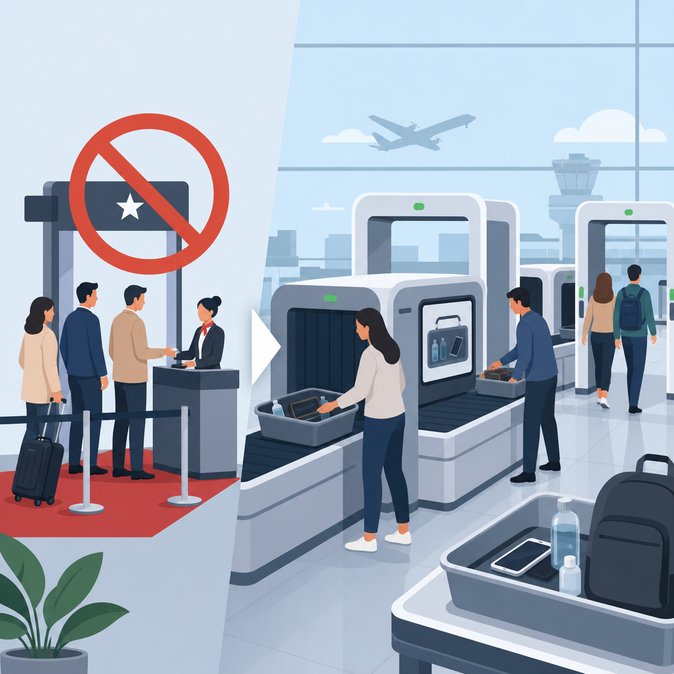
Flughafen Berlin Brandenburg (BER) announced on 21 May 2026 that it will discontinue the ‘BER Runway’ pre-booked security lane from 26 May. The decision follows months of plummeting demand after two key screening areas (Zones 1 and 5, Terminal 1) were fully retro-fitted with computed-tomography (CT) scanners allowing passengers to keep liquids (up to 2 litres) and electronics inside their bags. Introduced in August 2022 to tame pandemic-era queues, BER Runway offered travellers a reserved 20-minute slot in a dedicated X-ray lane. According to airport data, 90 % of customers who booked a slot in April abandoned it on the day and switched to the faster CT lines. With 24 CT-equipped lanes now open across Terminals 1 and 2, airport operator FBB concluded that the niche product no longer adds value to throughput or the passenger experience. For mobility managers this marks a shift in best practice at Germany’s third-busiest gateway. • Connecting itineraries: CT lanes have reduced average security dwell time from 18 to 7 minutes for non-Schengen connectors, easing tight MCT calculations. • Group moves: assignees arriving with family and multiple carry-ons benefit from not having to decant infant liquids or laptops. • VIP/fast-track policies: companies that paid for Runway slots (previously €12 per person) can strike that cost line; no replacement fee product is planned. FBB confirmed that the central lanes formerly used by BER Runway will also be upgraded; hardware has been ordered and installation is scheduled for the autumn infrastructure window. Until then they remain conventional X-ray checkpoints with 100 ml liquid restrictions. The German Federal Police emphasised that EasyPASS egates and the Entry/Exit System kiosks remain unaffected. Passengers can monitor live wait times via the BER-app, and signage will direct travellers towards the nearest CT lane. In practice, the demise of BER Runway is a sign that Germany’s large-hub airports are standardising on CT technology ahead of the EU-wide cabin-liquid rule changes expected in 2027. Corporate travel policies should be updated to remove obsolete guidance about pre-booked lanes and to brief travellers that, while CT scanners speed the process, ID and EES checks still apply.