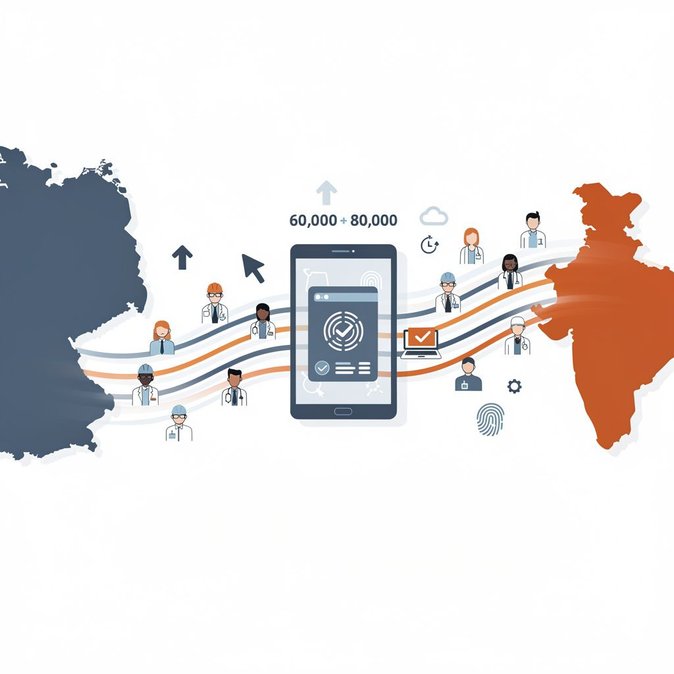
Germany’s newly appointed ambassador to India, Jasper Wieck, used his first formal press briefing in New Delhi on 23 September to set out an unexpectedly ambitious labour-mobility agenda. Germany currently issues about 60 000 national (D-category) visas each year to Indian nationals who come as skilled workers, researchers, intra-company transferees or students who later convert to work status. Wieck told journalists that the Federal Government wants to lift that ceiling to 80 000 per year – a one-third jump that would make Indians by far the largest cohort of third-country skilled migrants to Germany. The envoy framed the move as a "trusted-partner" response to Germany’s structural labour shortages, which the Federal Employment Agency puts at more than 400 000 unfilled positions. India was singled out because of the size of its talent pool and the momentum created by a just-concluded EU-India free-trade agreement and by April’s Indo-German Defence-Industrial Roadmap. According to Wieck, Berlin has already relaxed technology-export rules for joint defence production; easier mobility for engineers, IT specialists and healthcare staff is the next logical step. Practically, the increase will be underpinned by Germany’s new Skilled Immigration Act 2.0, which from November introduces the "opportunity card" (Chancenkarte) points system and lowers salary thresholds for the EU Blue Card. Indian applicants stand to benefit disproportionately because their professional qualifications are often on Germany’s shortage-occupation list. German missions in Mumbai, Delhi, Bengaluru and Chennai are piloting fully digital appointments and document upload to squeeze waiting times below six weeks – a chronic pain-point for Indian IT outsourcers and German Mittelstand companies alike. Corporate mobility managers should prepare for a surge in demand. HR teams will need to budget for additional German-language training (B1 or higher is still expected) and must monitor local processing capacities: despite digitisation, biometric capture will still require in-person visits. Employers should also note that the Federal Police continue to scrutinise fake language certificates; robust document verification remains essential. Strategically, the announcement signals that Berlin sees talent mobility as part of its wider Indo-Pacific tilt. By pairing defence-industrial cooperation with people-to-people flows, Germany hopes to diversify supply chains away from China while giving Indian professionals a clearer pathway to Europe’s largest economy. If the 80 000-visa target is met, Indian nationals could account for roughly 12 % of all residence titles issued to third-country workers in Germany in 2027 – a development that will ripple through salary benchmarks, housing markets and social-security systems.
Source: Business Standard