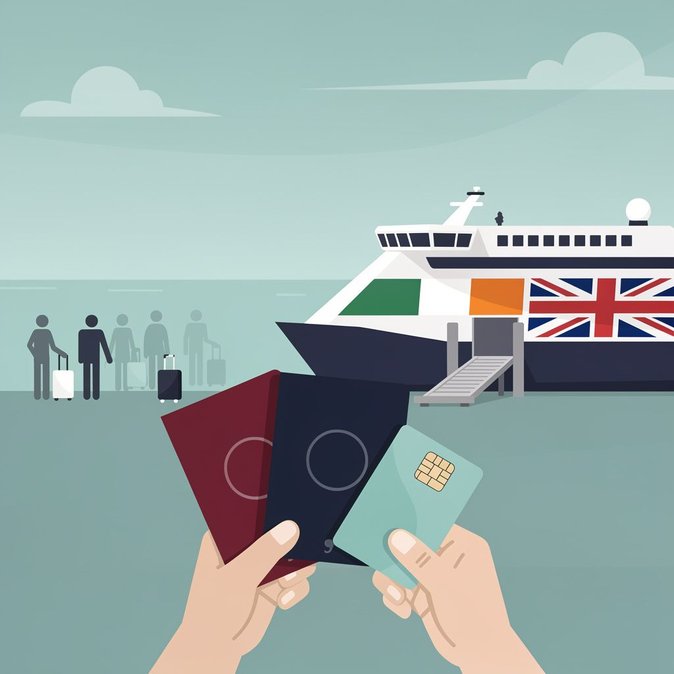
From today, 28 September 2026, passengers travelling by sea between the Republic of Ireland and Great Britain face a significant change at check-in: only a valid Irish passport, Irish passport card or other nationally-issued passport will now be accepted as proof of identity. Photo driving-licences, birth certificates and other forms of photographic ID that were previously tolerated on the short sea routes are no longer sufficient. Irish Ferries was first to publish the updated rules on its customer help-pages, confirming that every traveller on the Dublin–Holyhead, Rosslare–Pembroke and Dover–Calais routes must present a passport before boarding. Stena Line followed suit within hours, issuing identical requirements for its services from Dublin, Rosslare and Belfast. Both operators cite tighter carrier-liability obligations introduced by the UK government ahead of next year’s Electronic Travel Authorisation (ETA) scheme. The new regime obliges ferry companies to verify that all travellers are in possession of documentation that proves their immigration status or ETA exemption. In practice, Irish citizens remain visa- and ETA-exempt under the Common Travel Area (CTA). However, they must now carry a passport to demonstrate that exemption. The UK Foreign, Commonwealth & Development Office quietly updated its “Entry requirements” guidance this morning to reflect the rule change, while Ireland’s Department of Foreign Affairs amended its travel advice for Great Britain to warn citizens of possible boarding denials if they arrive at ports with insufficient ID. Business-travel specialists say the policy shift will have an immediate operational impact on firms that routinely send staff to Britain for day trips or rotational assignments. Corporate mobility teams have long relied on the convenience of photo-ID ferry crossings to move equipment and personnel who do not hold passports. Those travellers must now obtain travel documents or reroute via Northern Ireland, where land-border movements within the CTA are still document-light. Logistics advisers also caution that the stricter checks may lengthen embarkation times during the bedding-in period. HR teams are being urged to audit assignee documentation, update pre-travel briefings and budget for passport-application fees. Looking further ahead, carriers warn that the same passport standard is likely to extend to commercial drivers when the UK’s ETA becomes mandatory for non-British, non-Irish nationals in 2027. For now, organisations with frequent cross-channel movements should treat passports as compulsory for all ferry travellers, regardless of nationality, to avoid costly last-minute disruptions.