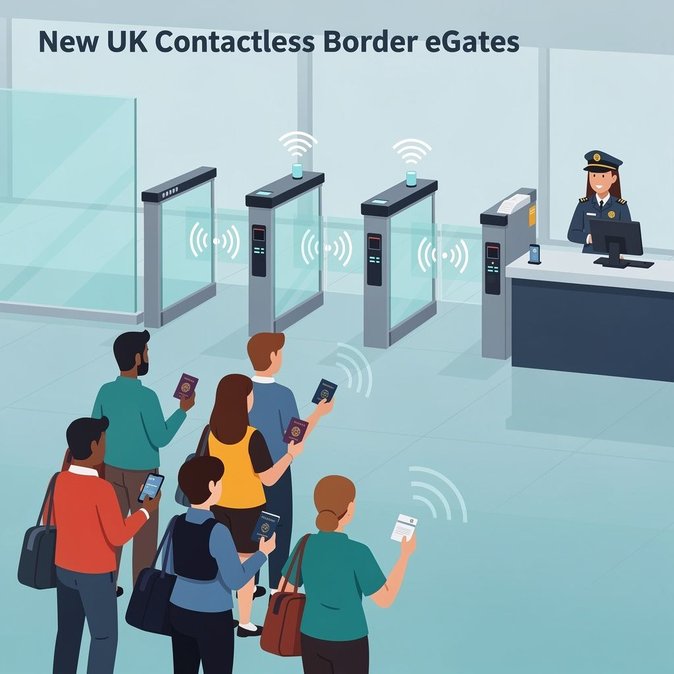
On 6 October Border Force quietly published a dedicated ‘Contactless travel using eGates’ page on GOV.UK that sets out exactly who can use the new system, where it is available and what to do if the facial match fails. The guidance confirms that contactless gates are currently restricted to British citizens and are live only at East Midlands Airport, but lists 12 additional airports—including Heathrow, Gatwick and Edinburgh—where deployment will follow over the coming months. Crucially for employers, the document clarifies that all immigration and security checks remain unchanged: travellers must still travel with a valid passport and may be asked to present it if further verification is required. The FAQs also note that travellers with dual nationality must enter on the same passport they used to apply for an ETA or eVisa, to avoid mismatches in the system. The page explains the circumstances under which a passenger will be diverted—for example, if they are under age 18, wearing headgear that obscures facial landmarks or flagged for secondary screening. In those cases, the eGate screen will instruct the traveller to place their passport on the reader or see an officer. Border Force encourages users to remove glasses, masks and hats to speed recognition and reminds them that live images are compared only with encrypted data already held by the Home Office. For global mobility teams this granular guidance is a valuable resource to embed in pre-departure briefings, especially for frequent flyers who may assume all gates are now passport-free. Advisers should highlight that the system will expand to other nationalities once performance targets are met, so non-UK employees may soon benefit—important for assignment cost planning and traveller experience metrics.
Source: GOV.UK – Border Force guidance