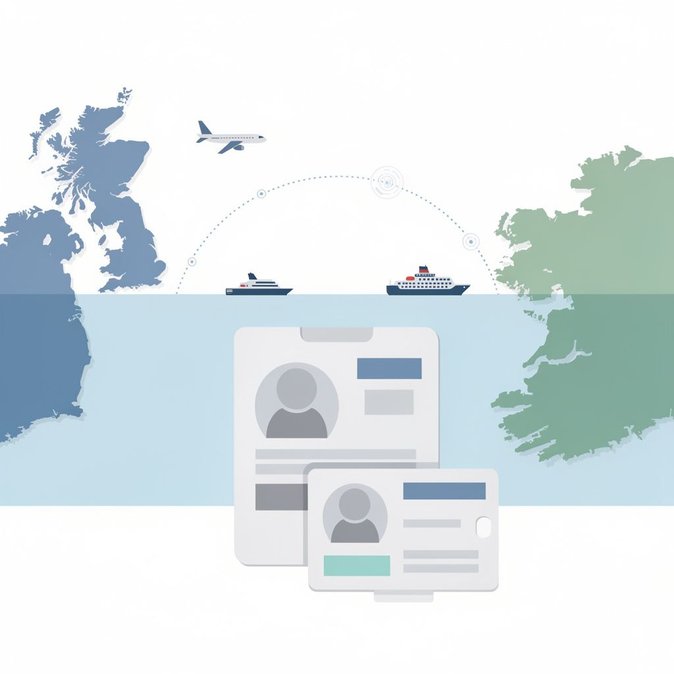
The United Kingdom’s Foreign, Commonwealth & Development Office (FCDO) has quietly amended its travel advice for Ireland, adding a new section on proof-of-identity requirements when moving between the two countries under the Common Travel Area (CTA). The guidance, published on 12 October 2026, clarifies that all travellers—including British and Irish citizens—may be asked to present valid photo identification when boarding a ferry or flight and when arriving at immigration control in either jurisdiction. Although the CTA has, since 1923, allowed British and Irish citizens to move freely without routine passport checks, carriers have increasingly asked passengers for photographic ID to meet carrier-liability rules and security obligations. The FCDO’s update brings official advice into line with prevailing airline and ferry practice, which typically accepts a passport, passport card, or in some cases a photographic driving licence. The change follows several high-profile incidents over the summer in which travellers were denied boarding at UK ports for carrying only a birth certificate or out-of-date student card. For corporate mobility managers the clarification is important. Employees flying from, for example, London to Dublin for meetings have sometimes assumed that no ID is needed—only to be turned away at the gate. Companies should therefore revise internal travel policies to state explicitly that a current passport or other approved photo ID is mandatory for all CTA movements, irrespective of nationality. Multinationals with large commuter populations crossing the Irish Sea are advised to circulate the updated rules to business travellers and dependants, and to audit any documentation lists provided in relocation handbooks. The announcement does not alter visa-free access for British and Irish nationals, nor does it affect non-EEA residents who already require a visa or pre-clearance to enter the Republic of Ireland. However, the FCDO emphasises that Irish immigration officers retain the right to carry out occasional spot checks within 100 kilometres of the border with Northern Ireland; foreign nationals should therefore carry their passport and any Irish residence permission when travelling internally. In the longer term, experts note that the clarification anticipates the rollout of the EU’s Entry/Exit System (EES) and European Travel Information and Authorisation System (ETIAS) in late 2026. While Ireland is not part of Schengen, technology upgrades being installed at Dublin and other Irish airports will make systematic ID scanning far easier, effectively institutionalising practices that were once informal. Firms should treat the FCDO notice as the “new normal” for CTA travel and ensure that HR and travel-booking systems flag the requirement at the point of reservation.