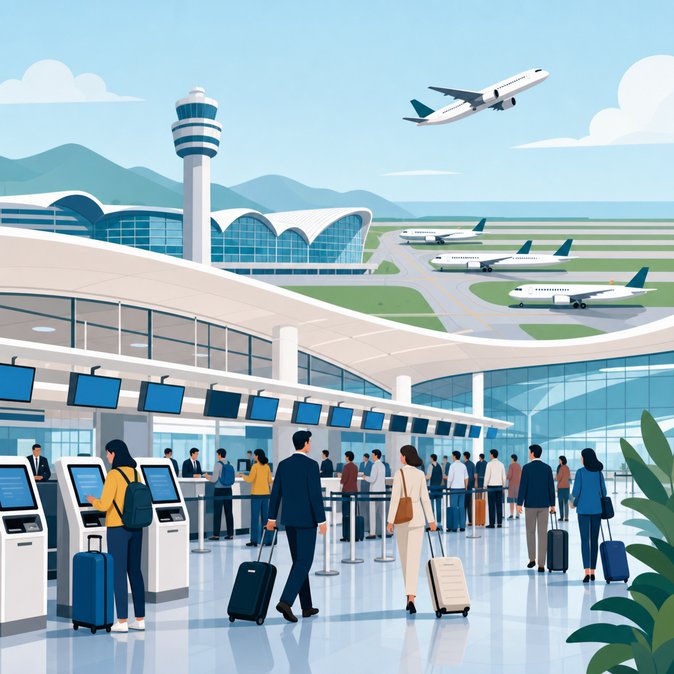
Hong Kong International Airport (HKIA) drew a line under nearly seven years of construction on 22 May 2026 when it cut the ribbon on its rebuilt Terminal 2 (T2). At a ceremony attended by Acting Financial Secretary Michael Wong, Airport Authority Hong Kong (AAHK) chairman Fred Lam and more than 1,500 industry guests, officials confirmed that the HK$12.9 billion upgrade will swing into passenger service on 27 May – just in time for the peak summer travel season. The re-imagined T2 is central to HKIA’s wider three-runway-system masterplan. The departure hall now offers 160 traditional counters, 48 self-bag-drop positions, next-generation biometric e-gates and re-engineered security lanes designed to process eight million passenger journeys in its first 12 months. Although passengers will still board flights from Terminal 1 until a dedicated T2 concourse opens in 2027, the two buildings are linked by the Automated People Mover and an air-conditioned footbridge, making transfers seamless. AAHK confirmed that 15 mostly short-haul and regional airlines will relocate their check-in zones to T2 in three waves between 27 May and 10 June. Launch carrier Hong Kong Airlines moves first, followed by Greater Bay Airlines, HK Express and a selection of Cathay Pacific flights. The phased approach is intended to stress-test new systems while minimising disruption for travellers and ground-handling partners. For businesses, the extra capacity is a tangible boost. Corporate travel managers anticipate shorter queues, more air-service options and better onward connectivity to the Greater Bay Area via the adjacent Airport Express, cross-border coaches and 29 airport bus routes that now call at T2. AAHK also used the opening weekend to stage a careers fair offering 4,400 vacancies across ground services, maintenance and security – a signal that head-count constraints that plagued aviation’s post-pandemic rebound are easing. With passenger traffic already back to 61 million in 2025 – 15 percent above 2024 – the airport believes it can now defend its crown as Asia’s pre-eminent gateway. The government, for its part, views T2 as proof that Hong Kong’s “Skytopia” vision of an integrated air-city district is on track, reinforcing the territory’s role as the preferred hub for multinational companies with regional headquarters and mobile workforces.
Source: South China Morning Post