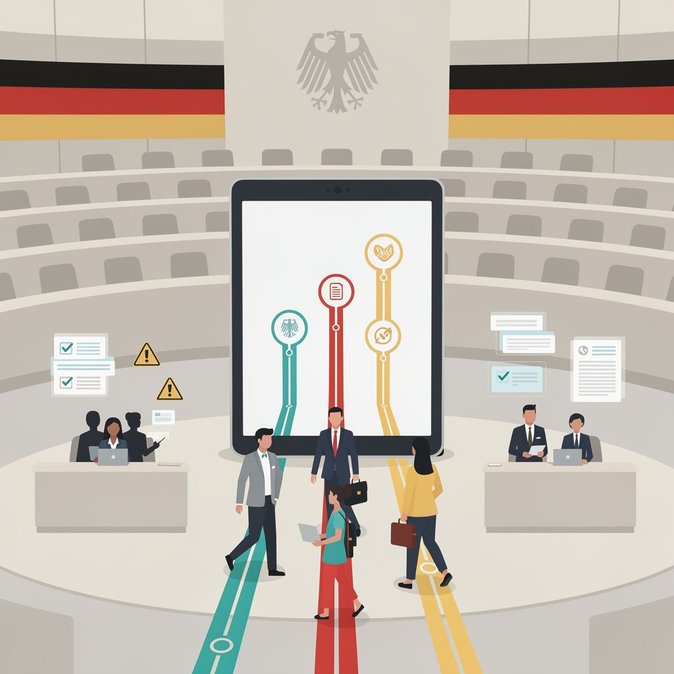
Germany’s long-running discussion over creating a single, easy-to-understand legal framework for immigration took a decisive step on 29 July 2026. In its 237th plenary sitting, the Bundestag held the first reading of a draft Einwanderungsgesetz tabled by the parliamentary group Bündnis 90/Die Grünen. The bill would bundle today’s patchwork of more than 50 separate residence titles into one coherent code, introduce plain-language criteria for economic, humanitarian and family migration, and place the principle of “managed openness” at the heart of German migration policy. Under the proposal foreign professionals could choose between three routes: 1) a points-based “Skilled Talent Track” that combines qualifications, language skill and experience; 2) an “Opportunity Card” for jobseekers with recognised vocational training; and 3) a fast-track for graduates of German universities. Humanitarian protection rules would be consolidated in a dedicated chapter, while spouses and minor children would gain an explicit legal right to accompany primary applicants immediately. Importantly, all residence titles would be issued digitally from day one and be fully compatible with the upcoming EU Digital Identity (EUDI) Wallet, reducing the administrative burden for companies and migrants alike. The Greens argue that a single Immigration Act will make Germany more competitive in the global contest for talent by offering clarity and speed. Employers’ federations support the move: the mechanical-engineering lobby VDMA estimates that vacancy-related production losses already cost the sector €14 billion a year. Regional authorities, however, warn that merging procedures without additional staff risks longer queues at foreigners’ offices unless processes are radically simplified. Interior Minister Alexander Dobrindt (CSU) criticised the draft as “too permissive” and said it overlaps with the government’s own plans to upgrade the existing Skilled Immigration Act. The bill has therefore little chance of passing in its current form, but the first reading forces all parties to spell out which elements they are prepared to support. Over the coming weeks the text will be scrutinised in the Internal Affairs and Labour committees; a second reading is pencilled in for September. If even parts of the draft survive, companies could see noticeably more flexible visa categories by mid-2027. For mobility managers the debate matters now: any consolidation of residence titles will affect how assignment policies are drafted, what documentation HR needs to collect, and which digital interfaces will be required to connect with German authorities. Multinationals are advised to map their most common visa scenarios against the three proposed tracks and start testing internal workflows for fully digital filings.
Source: Deutscher Bundestag