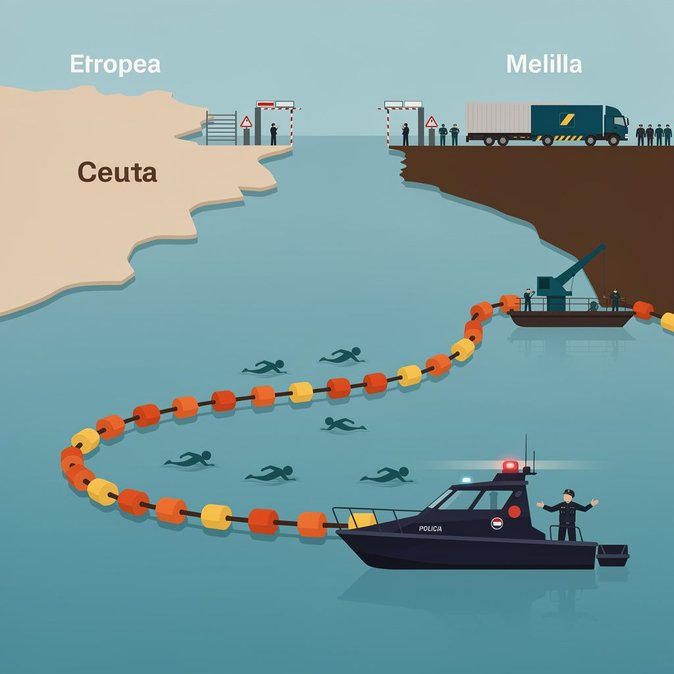
Just three days after installing a 500-metre floating boom off Ceuta, Spain’s Interior Ministry has quietly authorised police and Guardia Civil units to carry out immediate land returns of migrants who attempt to swim around the device—and signalled that a similar barrier will soon be anchored off Melilla. The instruction, signed by Secretary-of-State for Security Aina Calvo and seen by El País, extends so-called ‘devoluciones en caliente’ (hot returns) to Spain’s other North-African enclave despite a Supreme Court ruling in July that had limited the practice at sea. The order provides “legal certainty” for officers, Calvo writes, arguing that the sea may be a natural frontier but does not on its own constitute the “elemento de contención fronteriza” required by law to justify summary returns. By physically marking the maritime boundary, the ministry hopes to align practice with jurisprudence. For global-mobility teams, the policy matters on several fronts. First, the decision underscores Madrid’s determination to deter irregular arrivals after an unprecedented 50,000-plus migrants entered Ceuta on 30 July, prompting severe criticism from 22 EU capitals. Second, any extension of hard controls to Melilla—a key crossing point for road freight and seasonal workers—could disrupt legitimate border traffic with neighbouring Morocco while works are under way. Human-rights NGOs have already condemned the move as ‘cosmetic’ and warned that forced sea returns may expose Spain to litigation at the European Court of Human Rights. Meanwhile, the police union JUPOL says the order does nothing to address chronic staffing shortages. Companies with personnel transiting the enclaves should expect additional document checks on service roads and potential traffic slow-downs as maritime works begin.
Source: El País