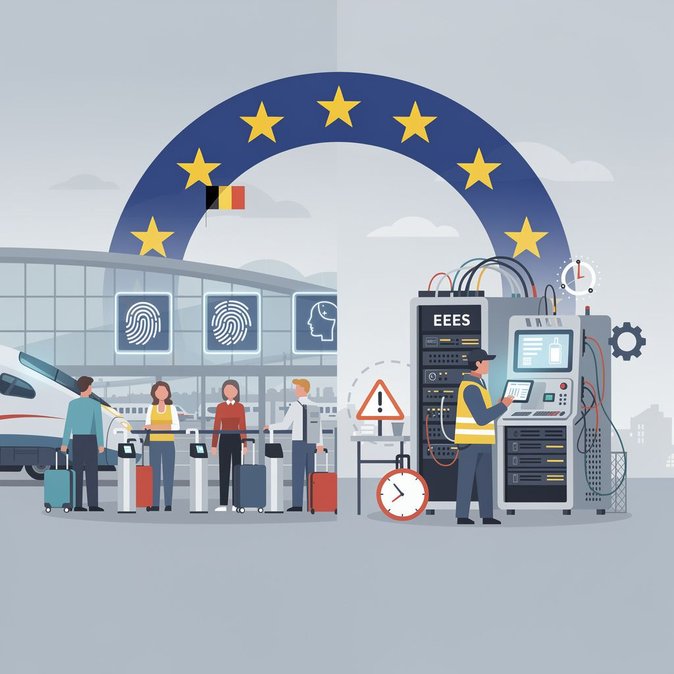
The European Commission has silently accepted requests from nine Schengen members—including Belgium—to postpone full enforcement of the EU’s new Entry-Exit System (EES). The last transitional clause that allowed countries to suspend the fingerprint-and-face scan requirement expired on 6 September, but Belgium, France, Germany, Greece, Italy, Malta, the Netherlands, Portugal and Switzerland informed Brussels that key border-crossing points were still not technically ready. According to documents seen by several media outlets, the Commission agreed on 14 September to let the nine states keep queues moving while they upgrade network capacity, install additional kiosks and train staff. The Guardian reports that fingerprinting has already begun at the Eurostar terminal in Brussels-Midi but not at regional airports such as Charleroi, underlining the patchwork nature of the roll-out. Only about 12 of 1,500 border points across the EU are still experiencing “critical” issues, yet those include busy holiday hubs such as Frankfurt and Schiphol. For Belgian businesses the reprieve is significant. During the summer test phase, handling agents at Brussels Airport warned of queues of up to 90 minutes when software crashed. Multinational employers with shuttles between Brussels and Paris had to reschedule meetings and in some cases charter cars to avoid missed connections. Travel managers told the Belgian International Mobility Forum that missed onward trains alone added roughly €400 per traveller to September budgets. The Commission insists EES “has not been suspended” and that derogations will be reviewed monthly. Carriers therefore still need to collect Advance Passenger Information and advise non-EU travellers that they may be asked for biometrics at either end of their journey. Yet the flexibility removes immediate pressure on operators such as Eurostar, which feared that St Pancras–Brussels services would become unviable if every non-EU passenger had to register in London at peak times. Looking ahead, officials in the Federal Interior Ministry say Belgium expects to complete full EES deployment at Brussels Airport’s non-Schengen pier by mid-November, followed by Ostend seaport in December. Business-travel stakeholders, meanwhile, are urging companies to keep adding 30 minutes of buffer time for all third-country nationals arriving in Belgium until at least the first quarter of 2027.
Source: The Guardian