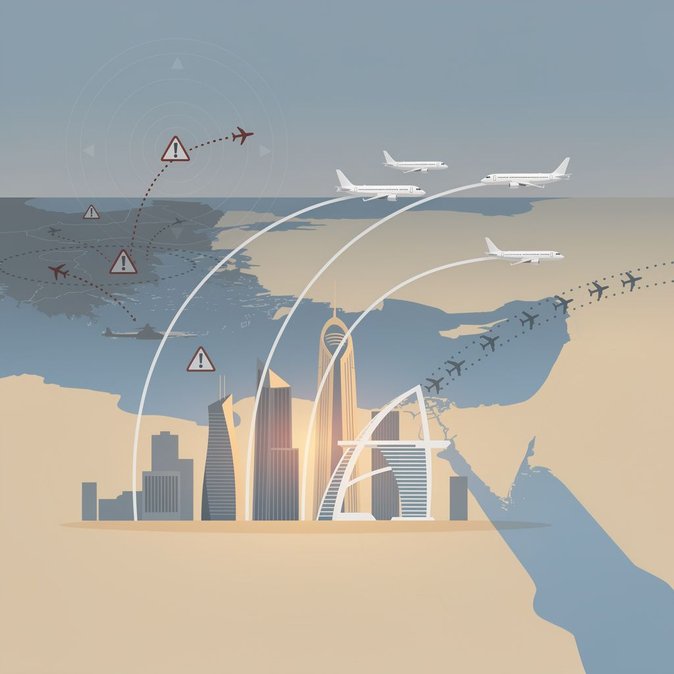
Despite continuing regional hostilities between the United States and Iran, Emirates and Etihad report that they are operating at more than 90 per cent of pre-war capacity and that winter forward bookings are strengthening. A Gulf News update on 16 September notes that Dubai Airports still expects to process around 70 million passengers in 2026—evidence of resilient demand even as security risks linger. The picture, however, remains mixed. More than 170 flights were delayed at Dubai International (DXB) and Abu Dhabi’s Zayed International Airport on 13 September, and a number of foreign carriers—including Air Canada, Virgin Atlantic and British Airways—continue to pause UAE services. Fuel prices, already above USD 107 a barrel, are another head-wind: Emirates says its hedging programme will cushion the blow, but ticket pricing could tighten if oil spikes further. Travel-risk consultants point to a “two-speed” environment: core long-haul routes to Europe, Asia and the Americas are largely intact, while services that transit or overfly flash-points near the Strait of Hormuz remain vulnerable to sudden cancellations or diversions. Both the UK and Australia have eased their advisories for the UAE in recent days, but the US State Department still keeps the country at Level 3—“Reconsider Travel”—and non-essential US government dependants have been authorised to depart. Corporate travel managers are therefore advising assignees and frequent flyers to build extra buffers into itineraries, keep mobile contacts updated with the airline and monitor airport channels right up to departure. Insurers report higher uptake of “disruption add-ons” that reimburse accommodation and alternative-routing costs when airspace closures hit. For the UAE economy, a sustained rebound in seat capacity is essential: aviation and tourism contribute roughly 13 per cent of GDP, and Expo-related infrastructure has further raised global connectivity expectations. Provided the conflict does not escalate, analysts believe traffic could return to the pre-war 100-million-passenger mark by end-2027, maintaining Dubai’s status as the world’s busiest international hub.
Source: Gulf News