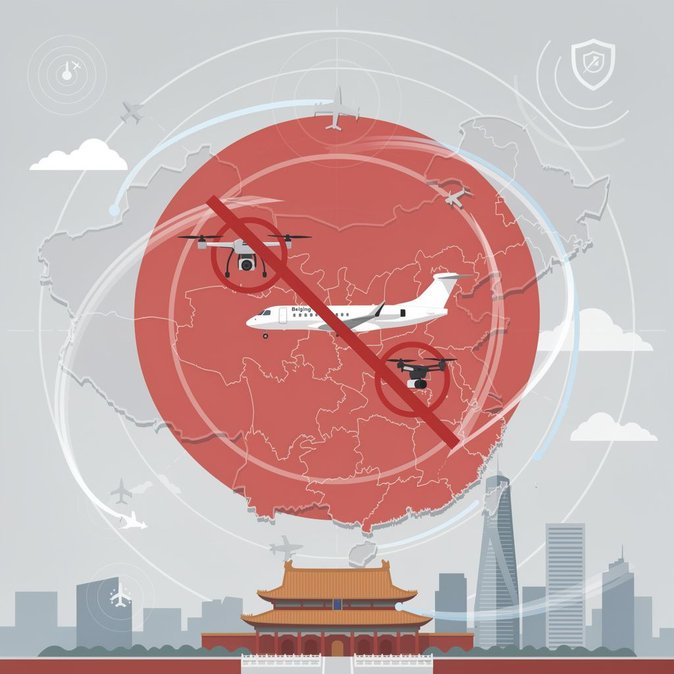
Beijing’s skies tightened dramatically today as Chinese authorities began enforcing a sweeping “Capital No-Fly Zone” that stretches roughly 600 kilometres in diameter around the city and spills into Tianjin, Hebei and parts of Inner Mongolia. According to state-run media cited by SBS News, the restricted airspace—at 280 000 km², 2.8 times the land-mass of South Korea—took effect at 00:00 on 20 September following a June incident in which a privately-piloted light aircraft slammed into the 528-metre CITIC Tower. Under the new rules, all non-commercial flights are prohibited unless individually cleared by military or civil-aviation authorities. The ban covers private jets, corporate helicopters, general-aviation sightseeing flights, and—most controversially—every category of civilian drone. Residents are being ordered to surrender hobby drones and even spare components at designated collection points; registered devices may receive token compensation of just CNY 200 (≈ USD 27), prompting a flood of complaints from small businesses that use unmanned aircraft for mapping, agriculture and last-mile delivery. Business-aviation operators report that Beijing Capital (PEK) and Beijing Daxing (PKX) will continue to accept scheduled passenger services, but corporate and charter slots are effectively frozen until new flight-approval software is rolled out later this year. Freight forwarders say high-value cargo previously moved on corporate aircraft—from semiconductor prototypes to urgent medical samples—must now be re-routed via Shanghai or Tianjin, adding a full day to door-to-door transit times. Compliance will be policed through a multilayered system that fuses military radar, ADS-B feeds and 5G-based low-altitude monitoring grids. Violators face fines of up to CNY 100 000 and criminal charges for “endangering airspace security.” The crackdown dovetails with China’s wider revision of exit-and-entry regulations, which took effect on 15 September and expanded the discretionary powers of border and aviation authorities. For multinationals, the immediate action items are clear: suspend any planned drone or demo flights near Beijing, reroute time-critical business-aviation missions through alternative gateways such as Tianjin (TSN) or Shijiazhuang (SJW), and alert travelling staff that recreational drone use is now illegal in the capital region. Companies that rely on UAV-based inspections should accelerate contingency planning for ground-based or satellite alternatives.
Source: SBS News