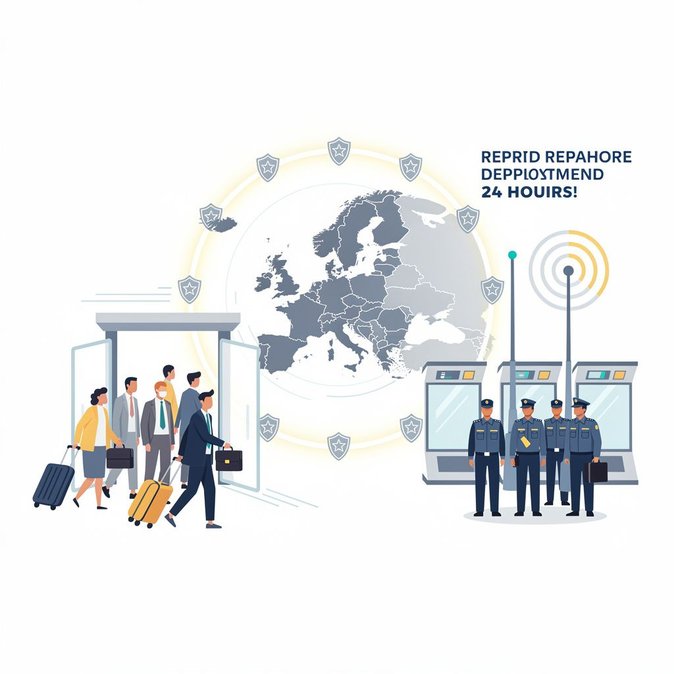
At a meeting of 17 European interior ministers in Munich on 26–27 September, Germany’s Interior Minister Alexander Dobrindt (CSU) called for a major overhaul of the European Border and Coast Guard Agency, Frontex. Dobrindt argued that the agency needs a permanently verfügbare, 1 000-strong rapid-response unit that can be flown to any EU external border within 24 hours to help local authorities manage sudden surges in irregular migration such as the mass crossing into Spain’s North-African enclave Ceuta this summer. The minister said the current ad-hoc deployment mechanism is “zu langsam und zu bürokratisch” and leaves frontline states unsupported during the critical first 48 hours of a crisis. He wants the new unit to have a clear legal mandate to carry out registration, screening and return procedures on the ground and, where necessary, to escort charter flights for immediate returns. Dobrindt also urged Brussels to authorise Frontex to organise returns directly from third-country transit zones, arguing that “Rückkehrzentren in sicheren Drittstaaten” are essential to break the business model of smugglers. The proposal received cautious backing from EU Commissioner for Migration Johannes Brunner, who noted that the Commission is already drafting a “European Crisis Response Framework” to be discussed by heads of state in October. Southern member states such as Spain and Greece welcomed the idea but insisted that any new powers must come with extra funding and stronger fundamental-rights monitoring. NGOs expressed concern that accelerated procedures could undermine access to asylum and judicial review. For companies that rotate staff across Europe’s external borders, a standing Frontex force could reduce ad-hoc travel disruptions if crises are stabilised more quickly. However, a tougher return regime may lead to stricter document checks at EU airports and land crossings, at least during deployments of the new unit. Mobility managers should therefore monitor the legislative process—initial Commission proposals are expected before year-end—with an eye on possible changes to carrier liability, passenger-data sharing and airport transit rules. If the initiative gains traction, Germany is likely to press for budget increases in the 2027–2031 Multi-Annual Financial Framework, meaning higher contributions from all member states. Businesses may wish to join industry consultations to ensure that facilitation programmes for trusted travellers are not rolled back in the name of security.
Source: Deutschlandfunk / Tagesschau