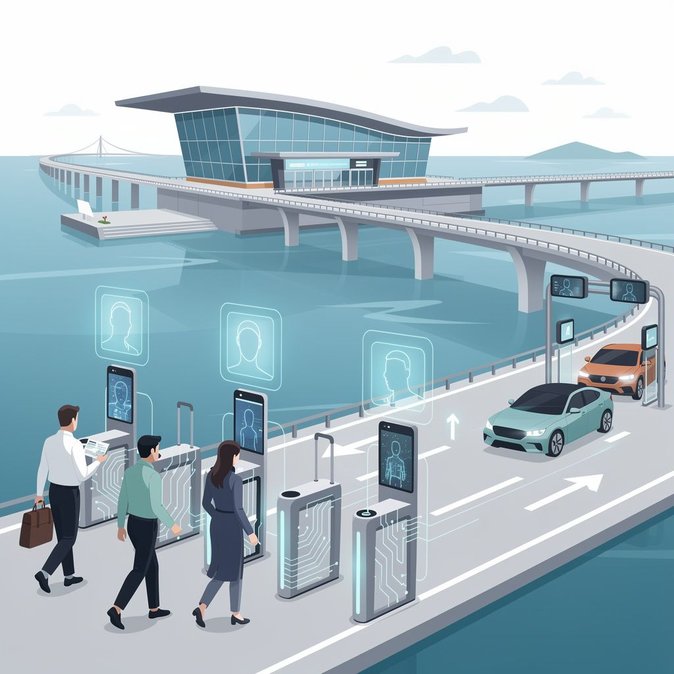
In a written reply to Hong Kong’s Legislative Council on 11 November, Secretary for Security Tang Ping-keung detailed how the territory will accelerate technology upgrades at land boundary control points with mainland China. The Immigration Department’s pilot Seamless e-Channel—launched at the Hong Kong-Zhuhai-Macao Bridge (HZMB) departure hall in June and expanded in September—has already enrolled more than 79 000 permanent residents and processed over 200 000 passenger trips without the need to present documents. The system uses facial-recognition cameras and artificial-intelligence matching to verify travellers in under 20 seconds, compared with roughly two minutes at staffed counters. Based on positive results, authorities plan to introduce the contactless gates to the HZMB arrival hall next and are studying deployment at West Kowloon high-speed-rail terminus and other busy crossings. Separately, Hong Kong and Shenzhen have agreed to replicate the “collaborative inspection and joint clearance” model—already live at the 24-hour Huanggang Port—when redeveloping Sha Tau Kok Control Point. That model allows travellers to clear both jurisdictions in a single hall, slashing queue times and easing congestion. The government also disclosed passenger-flow statistics: during 2026’s major holidays, Lo Wu averaged nearly 256 000 travellers a day, peaking at 274 000 during the Labour Day “golden week”. Lok Ma Chau Spur Line averaged just over 202 000. Officials said any permanent extension of Lo Wu’s operating hours beyond 02:00 would require joint approval with Beijing, factoring in staffing and transport-link capacity. For corporate mobility teams shuttling staff between Hong Kong and Shenzhen’s tech clusters, wider rollout of Seamless e-Channel promises significant time savings. Drivers of cross-boundary private cars should note that an automated on-board clearance pilot at HZMB will launch in December 2026, verifying all occupants via multi-camera facial scans without requiring them to leave the vehicle—ideal for executive road transfers to Zhuhai and Macau. Freight forwarders welcomed discussion of 24-hour cargo clearance at Liantang/Heung Yuen Wai, although officials gave no timetable, stressing resource constraints. In practical terms, HR managers should encourage frequent travellers who meet the six-trips-in-90-days threshold to enrol for Seamless e-Channel now, ahead of an expected year-end travel spike. Companies running shuttles across multiple checkpoints may need to update driver training to reflect differing clearance technologies at each port. Looking further ahead, Hong Kong’s integration of AI, biometrics and joint-inspection concepts mirrors Beijing’s wider push to digitise border control, signalling that tech-enabled, document-free travel could become the norm for Pearl River Delta commuters by 2027.