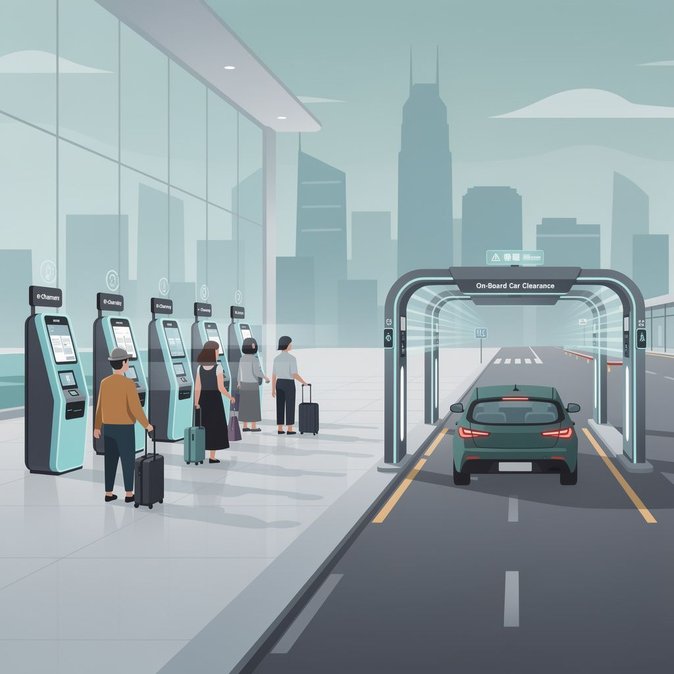
Hong Kong’s cross-boundary travellers are about to see queues shrink dramatically. In a written reply to the Legislative Council released on 11 November, Secretary for Security Chris Tang laid out a multi-year modernisation plan for all nine land Boundary Control Points (BCPs) linking the city to Shenzhen and the Greater Bay Area. The Immigration Department has already enrolled more than 79,000 frequent users in a pilot “Seamless e-Channel” at the Hong Kong–Zhuhai–Macao Bridge (HZMB) departure hall. Using AI-driven facial recognition, eligible passengers can complete both identity verification and immigration clearance without presenting a passport or smart ID card. Next on the timeline is the Automated Transportation On-board Clearance System, due to launch in December 2026 at HZMB. Pre-registered Hong Kong permanent residents in private cars will be scanned by multiple cameras while seated; the system matches faces to the Transport Department’s database in roughly 20 seconds—down from the current two-minute average. Officials say the technology will be rolled out to other control points once performance and security testing are complete. The government is also negotiating with Shenzhen to replicate the “collaborative inspection and joint clearance” model—already used at Huanggang Port—when the ageing Sha Tau Kok checkpoint is redeveloped. During major 2026 holidays, daily passenger throughput at Lo Wu exceeded 260,000; authorities argue that more automation is essential to absorb further growth driven by Greater Bay Area commuting and tourism rebounds. For logistics operators, the plan contains goodies too: 24-hour cargo clearance continues at Shenzhen Bay, and discussions are under way to let private cars with existing quotas use alternative checkpoints during off-peak night hours. Freight forwarders expect faster door-to-door times, while mobility managers see fewer late-night border bottlenecks for assignees living on one side of the boundary and working on the other. Corporates are advised to monitor December’s pilot and encourage mobile staff to sign up early once additional enrolment locations open. Early adopters could shave hours off weekly commute times, improving productivity and employee satisfaction.
Source: SCLA Legal Observatory