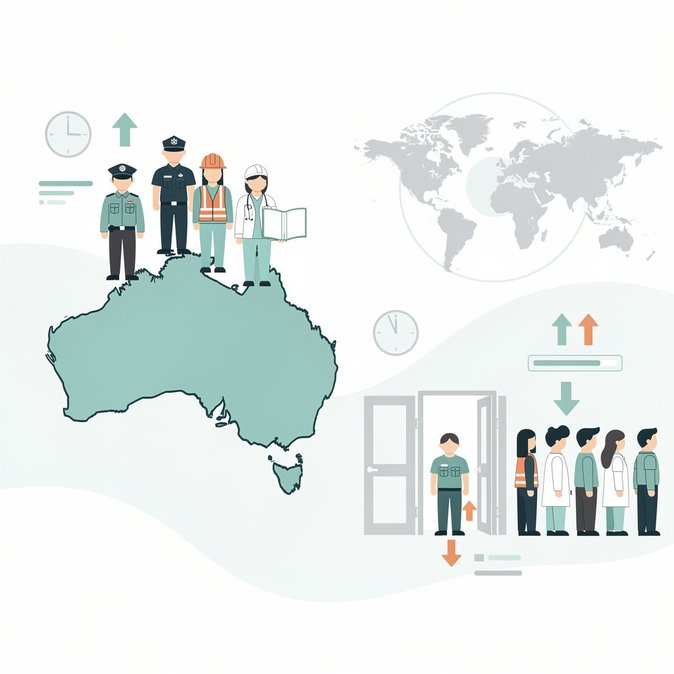
The Australian Department of Home Affairs has published Ministerial Direction 119, a binding instruction to visa decision-makers that radically reshapes the order in which skilled‐migration nominations and visa applications are processed. Signed by Home Affairs and Immigration Minister Tony Burke and effective the day after signature, the new direction formally revokes Direction 105 and covers the full suite of permanent and provisional skilled visas, from the Subclass 186 Employer Nomination Scheme to the Subclass 494 Skilled Employer-Sponsored Regional visa. Under Direction 119, applications are now triaged on two axes: the applicant’s occupation and their physical location at lodgement. Top priority is reserved for on-shore applicants filling law-enforcement or defence-related roles, followed by their offshore counterparts. Construction, healthcare and teaching occupations move into the next tiers, again with on-shore cases ahead of offshore. All remaining skilled applicants in Australia are placed in the fourth tier, while those outside the country fall to the fifth and final tier. Crucially, the Direction extends the priority framework to the new Skills-in-Demand visa stream (Subclass 482), signalling the government’s intent to align temporary talent pipelines with permanent migration objectives. For employers, the change promises faster decisions where they are sponsoring workers already contributing to the Australian labour market—particularly in sectors grappling with acute shortages such as nursing, aged care, civil engineering and housing construction. Businesses that had been relying on offshore recruitment should expect longer lead times and may need to revisit workforce planning, labour-agreement strategies and relocation budgets. Migration advisers are urging HR teams to file on-shore nomination upgrades quickly, ensure occupation codes match the newly enumerated priority lists, and lodge ‘decision-ready’ applications to capitalise on faster queues. Prospective skilled migrants currently in Australia—many on graduate, working-holiday or temporary skill-shortage visas—stand to gain the most. By converting to higher-value visas while on-shore they leapfrog offshore candidates, a move likely to intensify competition for state and territory nominations. Offshore applicants, meanwhile, must prepare for extended processing times unless they possess construction, healthcare, teaching or defence credentials. Direction 119 sits within the government’s broader Migration Strategy, which aims to cut red tape, curb exploitation and better match migration intake to areas of genuine economic need. Although welcomed by industry groups such as the Housing Industry Association and Aged & Community Care Providers Association, the pivot has drawn criticism from regional employers who argue that offshore recruitment remains vital where local talent is scarce. The Department has indicated it will monitor processing times and may refine priorities through subsequent directions, leaving room for further policy evolution in the months ahead.
Source: Department of Home Affairs