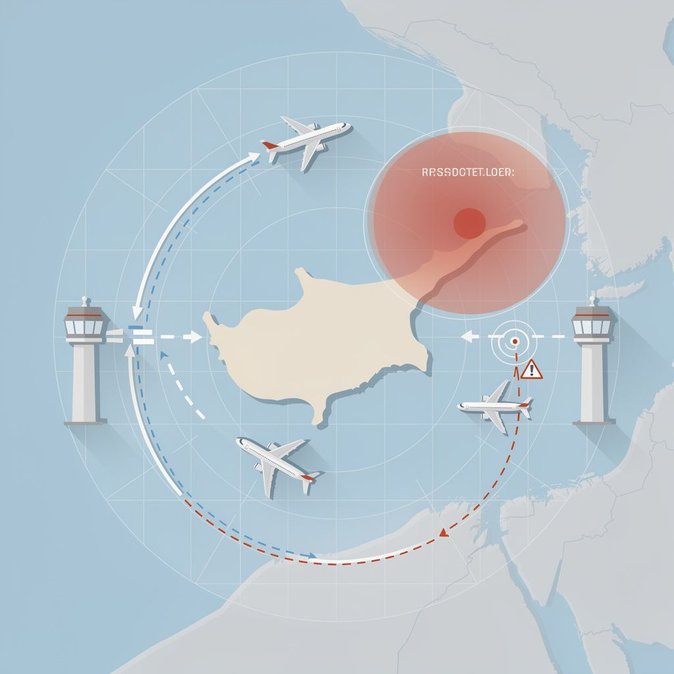
For the second time in as many months, the Department of Civil Aviation has warned that the island’s strategic position in the Eastern Mediterranean is being undermined by the stand-off with Turkey over the Nicosia Flight Information Region (FIR). Speaking to MPs on 18 September, acting director Haris Antoniades laid out— in unusually candid terms — why the long-running political dispute now poses a direct operational threat to airlines that use Cypriot airspace. Antoniades reminded parliament that the Nicosia FIR is far larger than the Republic’s territorial airspace, stretching north to the Turkish coast and east towards Syria, Lebanon and Israel. Every commercial flight entering that 175,000 sq km block is, on paper, under Cypriot control. Yet Ankara refuses to accept instructions from Nicosia and, through the un-recognised Ercan/Tymbou tower in the north, clears traffic on separate radio frequencies. The absence of coordination has already led to “numerous near-misses that are quietly de-escalated by over-worked controllers,” he said. While Cyprus continues to cooperate smoothly with Greece, Israel, Lebanon and Egypt, Turkey remains the only neighbouring state that does not exchange real-time flight plans with Nicosia. That leaves pilots juggling conflicting instructions, especially when weather deviations or medical emergencies require rapid altitude or routing changes. The Civil Aviation Department has contingency procedures — including reducing sector capacity or closing portions of the FIR — but Antoniades warned that these are temporary fixes. “The permanent solution is political: two recognised states that can talk to one another as every other pair of neighbours does,” he told legislators. MPs also heard that staffing and technology shortfalls exacerbate the problem. A proposal to spin off air-navigation services into a state-owned company, freeing it from civil-service hiring freezes, will go before Cabinet next month. But even a modernised centre cannot eliminate the underlying risk as long as radio silence with Ankara persists. Business-travel groups have taken note: several multinationals told the Cyprus Mail they have inserted new contractual clauses allowing crews to refuse routings that enter the conflict zone without penalty. For corporate mobility managers the message is two-fold. First, continue to monitor NOTAMs for last-minute flow-control restrictions that can delay tight connections through Larnaca or Paphos. Second, recognise that any abrupt escalation in east-Mediterranean tensions could trigger pre-emptive air-space closures — something the Department has not ruled out. Advance contingency planning, including alternative routings via Athens FIR, is therefore prudent for time-critical cargo and executive travel.
Source: Cyprus Mail