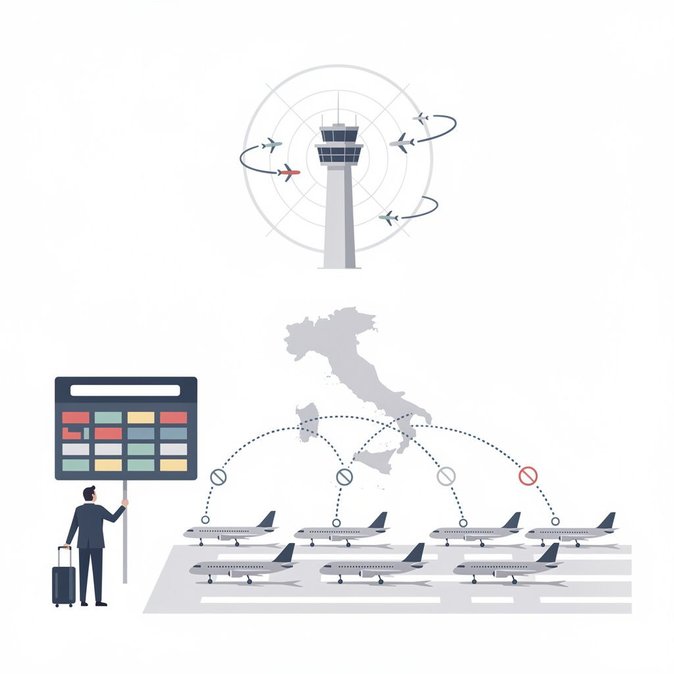
The last industrial action of the month has been formally confirmed: from 13:00 to 17:00 on Wednesday, 30 September, air-traffic-controllers at ENAV centres in Bologna, Bari, Milan-Linate and Naples, as well as staff at Rome’s Via Appia Nuova and ENAV headquarters, will walk out. Technical-services provider Techno Sky will join the four-hour strike, potentially complicating the restoration of normal operations once the stoppage ends. Under Italian law certain ‘protected’ time-bands apply—07:00-10:00 and 18:00-21:00—during which essential flights (medical, search-and-rescue, and a limited number of commercial rotations) must be guaranteed. ENAC, the Italian Civil Aviation Authority, will publish the official list of protected flights 48 hours in advance. Airlines have already begun pro-actively trimming their Wednesday schedules; early indications suggest Alitalia-successor ITA Airways will cancel roughly 20 percent of domestic services, while Ryanair has warned of knock-on delays throughout its European network. For mobility managers the key date is Monday, 28 September, when carriers must notify passengers of cancellations and allow fee-free rebookings. Because the strike is a ‘local labour dispute’ and announced well in advance, EU261 compensation is not payable, but airlines must still offer rerouting or refunds. Travellers connecting through Italy that day should build in longer layovers and avoid tight rail-to-air itineraries, especially at Milan-Centrale where Malpensa Express services are already operating at reduced frequency due to engineering works. Cargo operators are also bracing for delays. ENAV’s brief covers overflight as well as airport services, so freighters transiting Italian airspace may need to accept level capping or reroute via Croatian or French sectors. Forwarders shipping time-critical pharmaceuticals from Milan and Roma Fiumicino should consider shifting loads to road or sea if delivery windows are inflexible. Although strikes are a recurring feature of the Italian transport calendar, this action comes at a sensitive time: the IATA winter schedule begins on 25 October, and slot-coordination deadlines for the 2026 Christmas peak are imminent. Any backlog next week could ripple into slot-allocation meetings, so airlines with heavy Italy footprints are lobbying the Ministry of Transport to ring-fence night-time clear-down windows.
Source: The Flight Club