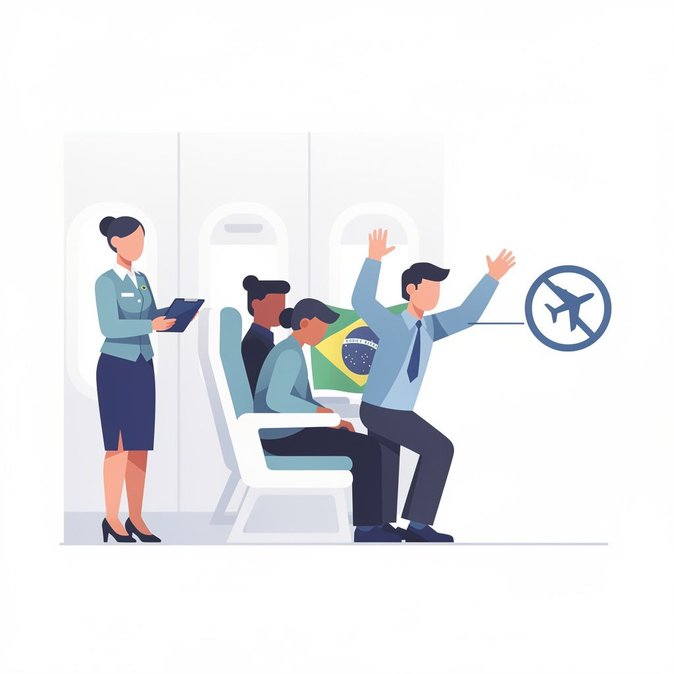
Starting Monday, 14 September 2026, anyone who misbehaves in a Brazilian airport or aircraft can be grounded for up to 12 months and fined R$ 17,5 mil under the new Resolution 800/2026 of the National Civil Aviation Agency (ANAC). The regulation, published earlier this year but now in force, creates a three-tier system that classifies incidents as ordinary, serious or very serious. Ordinary acts—such as refusing to stow electronic devices—will trigger an on-the-spot warning from the airline. Serious acts (for example, shouting threats or smoking on board) allow the carrier to remove the traveller and automatically triggers the fixed fine. Very serious behaviour—physical aggression, sexual harassment, damage to safety equipment or attempts to enter the cockpit—adds the possibility of a nationwide suspension of boarding rights for six or twelve months. To enforce the bans, carriers have agreed to share data in real time and maintain a single national list of barred passengers. Airlines must notify the traveller of any sanction and guarantee due-process rights, but ANAC’s director-general Tiago Faierstein admits the agency expects a wave of lawsuits and has prepared a legal defence strategy. The move comes after a record 1,764 cases of passenger indiscipline were logged in 2025—an increase of 66 % in one year. Brazilian carriers estimate that each diversion caused by disorderly conduct costs between R$ 80 000 and R$ 150 000 in fuel, crew and passenger re-accommodation. Business-travel managers welcomed the tougher stance, saying that predictable cabin environments are essential for maintaining aggressive corporate travel schedules. Travel-risk advisers add that multinationals should brief staff on the new penalties, as a mid-trip ban could strand an employee and invalidate onward tickets purchased under the same reservation code. Brazil’s rules mirror a global trend. The U.S. FAA adopted a zero-tolerance policy in 2021, and the EU is debating cross-border no-fly lists. For companies whose assignees shuttle frequently between São Paulo, Brasília and regional hubs, the message is clear: disruptive behaviour is no longer just a PR issue—it can ground careers as well as aircraft.
Source: Agência Brasil