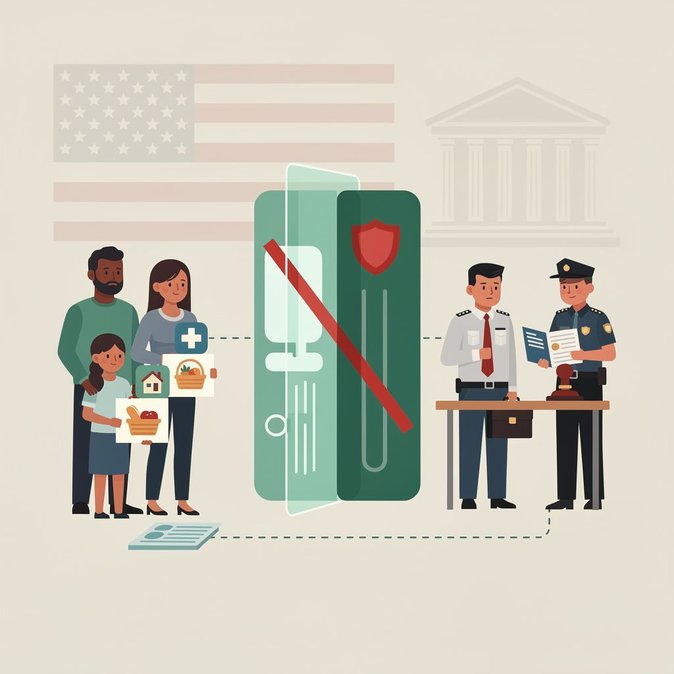
The most consequential change to U.S. immigration self-sufficiency standards in decades quietly took effect on September 18, 2026. Under the new Department of Homeland Security (DHS) “public-charge” rule, consular officers and U.S. Citizenship and Immigration Services adjudicators must now treat a broad range of non-cash public benefits—including Medicaid, the Supplemental Nutrition Assistance Program (SNAP), Pell Grants, free school lunches and housing subsidies—as negative factors when deciding whether a foreign national is “likely at any time to become a public charge.” The rule, first proposed in 2025 and fast-tracked this summer, overturns decades of guidance that limited public-charge findings largely to long-term institutional care and cash welfare. DHS estimates the policy could prompt up to 950,000 people annually to forego benefits, trimming roughly US $13 billion in federal and state expenditures. Immigration lawyers, however, warn that the absence of bright-line thresholds will inject enormous discretion into green-card adjudications, encouraging officers to deny permanent residence whenever any benefit use appears in an applicant’s record—and chilling eligible U.S. citizen children from obtaining nutrition or medical assistance. Business immigration stakeholders see immediate downstream effects. Adjustment-of-status filings may now require exhaustive financial documentation to rebut public-charge concerns, lengthening internal mobility timelines for multinational transferees and new-hire sponsorships. Employers expecting to file Form I-485 packages after October 1 are advising foreign national staff to obtain private health-insurance quotes, consolidate assets and avoid benefit enrollment to strengthen their cases. Human-resources teams are also reviewing relocation allowances, since housing or meal stipends provided by the company are explicitly exempt from the rule and can substitute for public assistance. Twenty-two states, the District of Columbia, and several major cities filed suit in the Southern District of New York within hours of the rule’s implementation, calling it “arbitrary, capricious and cruel.” Plaintiffs argue the policy exceeds DHS authority and ignores economic studies showing immigrants’ long-term fiscal contributions. While preliminary injunction motions are pending, DHS insists the regulation “faithfully executes Congress’s intent that aliens be self-reliant.” Until a court says otherwise, mobility managers must assume the rule applies to all family- and employment-based adjustment filings initiated on or after September 18. For employers and relocation providers, the practical checklist is clear: audit benefit use during pre-hire screening, counsel employees on permissible aid, and budget additional legal time to craft public-charge rebuttal briefs. Failing to anticipate the new evidentiary burden could leave key talent stranded in nonimmigrant status or forced to depart the United States altogether.
Source: The Washington Post