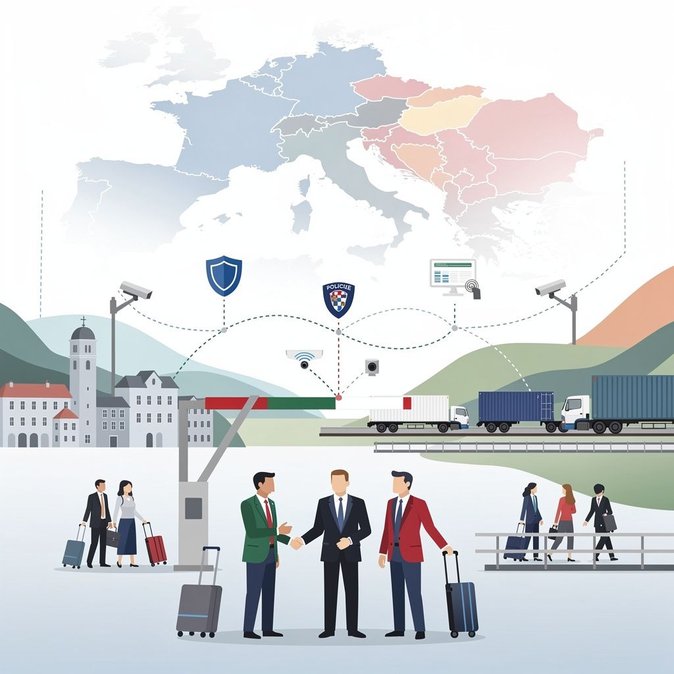
Interior ministers Matteo Piantedosi (Italy), Franci Matoz (Slovenia) and Davor Božinović (Croatia) met on 22 September in Villa Cattaneo, just outside Pordenone, for the seventh trilateral summit devoted to security and migration along the north-eastern frontier. The gathering comes three years after Rome re-introduced police controls on its 230-kilometre land border with Slovenia—a measure that technically suspends the Schengen free-movement regime until 18 December 2026. According to officials, discussion centred on three dossiers: harmonising visa practices for Western-Balkan nationals, expanding joint police patrols on the so-called Balkan route, and drafting a roadmap that would allow Italy to lift fixed checkpoints while preserving “equivalent” security through real-time data-sharing and mobile patrols. Vienna and Brussels have been pressuring Rome to normalise the border ahead of the EU’s new Pact on Migration and Asylum, which becomes fully applicable next June. Minister Piantedosi signalled cautious openness, noting that the cost of static border deployments—estimated at €20 million a year—has fallen as 170 new officers graduated from police academies and redeployed locally. His Slovenian counterpart, however, insisted that the suspension should end “as soon as possible” to restore economic fluidity in the cross-border region, which hosts integrated supply chains for automotive, life-science and logistics firms. For companies shuttling staff and goods between Italy’s Friuli-Venezia Giulia region and Slovenia’s Primorska, the main practical takeaway is that checks will remain in place this autumn. Travellers should add 10-20 minutes for document inspections at the 13 staffed crossings, especially at Fernetti and Sant’Andrea/Škofije, and expect random spot checks on secondary roads. Employers planning year-end assignment cycles should also watch for a fresh Italian decree in December, which Rome must file with the European Commission if it wishes to extend the controls into 2027. In the meantime, the three ministers agreed to meet again before Christmas and to pilot a shared watch-list platform fed by each country’s national passenger-name-record (PNR) databases. If successful, that digital layer could become the technological justification for finally restoring full Schengen travel in 2027.