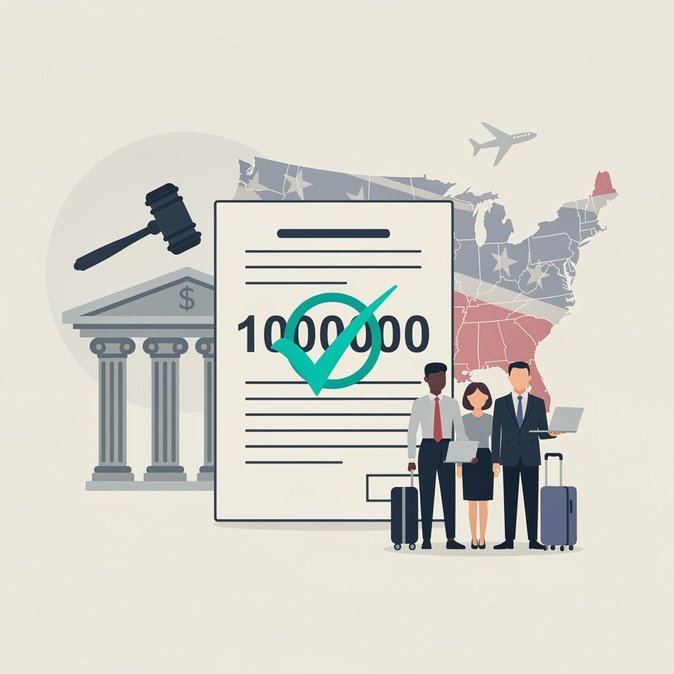
In a major victory for U.S. employers and foreign talent alike, Judge Haywood S. Gilliam Jr. of the Northern District of California issued an injunction on 30 September—publicly released on 4 October—blocking federal agencies from **enforcing a presidentially mandated US$100,000 payment** on each new or extended H-1B petition. The surcharge, created by Proclamation 10973 in 2025 and extended last month, was intended to ‘offset labour market harms’, but employers argued it was a de-facto tax that exceeded executive authority. Plaintiffs in Global Nurse Force v. Trump included hospitals, universities, tech firms and religious organisations that depend heavily on specialty-occupation workers. The judge agreed they were likely to prevail on claims that the fee violated the Administrative Procedure Act because agencies skipped notice-and-comment rule-making and acted in an arbitrary, capricious manner. U.S. Citizenship and Immigration Services, CBP and the State Department are now barred from conditioning petition approvals, change-of-status decisions or visa issuance on payment of the fee. For corporate mobility programs, the injunction removes a budgetary bombshell that threatened to make H-1B transfers prohibitively expensive and to divert resources from relocation packages and compliance budgets. Immigration counsel stress, however, that **the underlying proclamations remain on the books** and could be re-engineered through proper rule-making, so companies should continue to model potential cost scenarios. The ruling also leaves untouched DHS’s separate proposal for a US$103,265 H-1B cap-petition fee that is still in the notice-stage. The decision marks the second defeat for the surcharge after a Massachusetts court vacated parallel guidance in June. Conflicting district-court outcomes increase the odds of appellate review—and possibly a Supreme Court showdown—over how far a president can go in imposing fiscal conditions on employment-based immigration without congressional action.
Source: London Insider