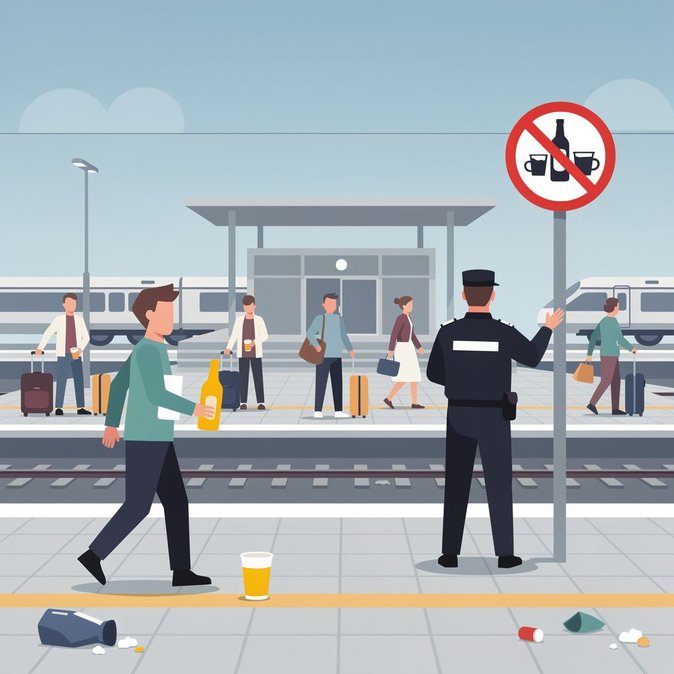
Business travellers arriving at German rail hubs today will notice a new message over the loud-speakers: “Alkoholverbot.” As of 15 October 2026 the Deutsche Bahn (DB) has rolled out a blanket ban on alcohol consumption in every station and on every platform across its 5,700-strong network. The decision follows an 18-month pilot at 40 large terminals—including Cologne, Munich and Hamburg—where DB logged a measurable drop in aggressive incidents, litter and staff assaults. Under the new rule passengers may still buy and drink beer or wine inside licensed bars and restaurants within the concourse, but open containers are prohibited elsewhere. Violations trigger an immediate removal from the premises and, for repeat offenders, a station-wide exclusion order. DB security teams, supported by Bundespolizei patrols, have been briefed to enforce the regulation uniformly, whether the offender is a stag-party group or a homeless individual. Surveys cited by DB claim 80 percent public support, yet social service organisations warn the problem may just migrate to forecourts and adjacent streets, shifting, not solving, safety concerns. For corporate mobility managers the implications are practical and cultural. Travellers accustomed to grabbing a beer for the ICE ride must adapt, and companies should adjust travel-policy language to reflect that, outside long-distance trains, station drinking is now off-limits. Duty-of-care teams will welcome any reduction in late-night platform harassment, a frequent complaint from female staff and international visitors. Retail concessions, meanwhile, are bracing for lower kiosk revenue and may push for rent relief. International assignees should know that rules differ once onboard: long-distance ICE and Intercity services still allow alcohol, whereas regional operators decide individually. DB will review the ban’s effectiveness after the first six months, measuring incident data and passenger surveys. If positive, the model could influence other European rail operators wrestling with station-safety debates from Paris to Amsterdam. Legal observers note that Germany’s Railway Regulation Act grants DB considerable leeway to issue house rules, but court challenges are possible if enforcement is seen as discriminatory. HR departments should monitor case law, especially if employees on commuter passes face fines for inadvertent breaches during multi-leg journeys.
Source: Tagesschau