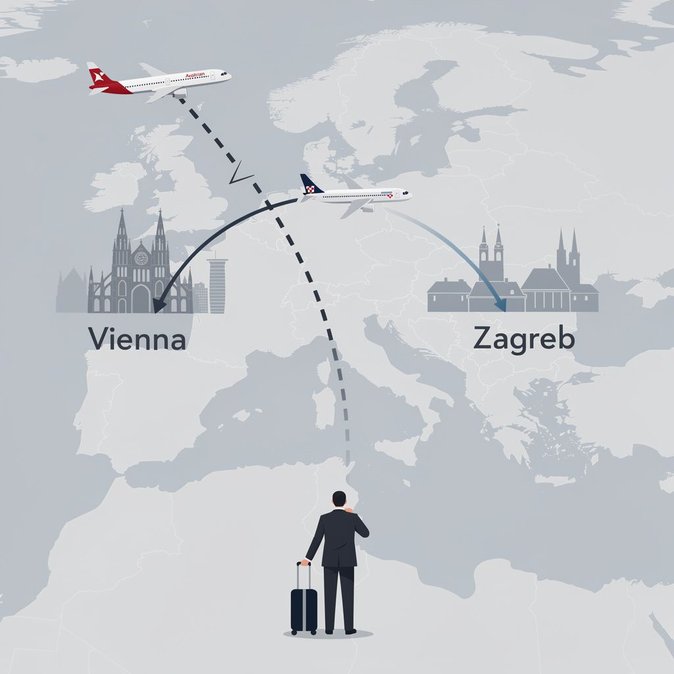
Austrian Airlines (OS) confirmed on 22 October 2026 that it will permanently withdraw its daily Vienna–Zagreb rotation as of 10 January 2027, ending more than 40 years of continuous operations between the Austrian and Croatian capitals. According to the carrier, the decision is part of a broader winter-network optimisation that concentrates capacity on higher-yield European gateways and long-haul feed. The route once offered up to 12 weekly frequencies but had already been reduced to a single daily Embraer 195 flight during summer 2026 as competition from Croatia Airlines (OU) and low-cost carriers pressured yields. The withdrawal will leave Croatia Airlines as the sole operator on the 318-kilometre sector. Croatia’s flag-carrier has already filed two daily Dash-8 Q400 flights for the IATA winter 2026/27 season, which begins on 25 October 2026, partly to protect Star Alliance connectivity beyond Vienna. For Austrian business travellers, the loss of the early-morning OS603 departure means less schedule flexibility and fewer same-day return options—especially for commuters working in Zagreb’s growing life-science and shared-services clusters. Corporate travel managers are being urged to review policy-approved carriers and negotiate through-fares that combine OU sectors with Austrian Airlines or other Lufthansa Group airlines to maintain through-tagged baggage and lounge access. Travellers holding tickets dated after 10 January will be offered re-routing or refunds, but seats in business class are already scarce on replacement flights. Multinationals with intra-CEE shuttle programmes may need to consider rail alternatives such as the ÖBB Nightjet service via Maribor, although door-to-door times increase by at least three hours. In the medium term, Vienna Airport (VIE) loses another short-haul service just as management warns of a 7.5 % passenger drop in September 2026. Aviation analysts note that the cancellation highlights Vienna’s struggle to keep regional spokes profitable amid rising airport charges and Austria’s flight tax. Zagreb Airport (ZAG), for its part, faces the prospect of lower inbound connectivity for investors—even as it seeks to reverse six months of soft passenger numbers. The move underscores how secondary city-pairs are increasingly vulnerable when network carriers rebalance fleets toward long-haul growth and leisure hubs.
Source: HRT – Glas Hrvatske