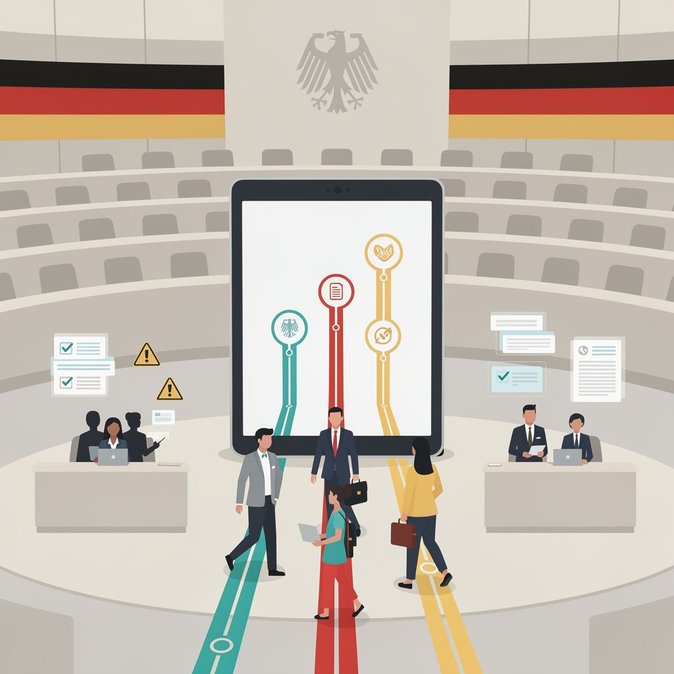
Berlin – In a late-night sitting on 29 July 2026 the German Bundestag began the first reading of a draft Immigration Act introduced by the Green parliamentary group. The proposal – long promised by the three-way coalition but now formally tabled – aims to replace the current patchwork of more than 50 separate provisions with a single, modern framework for labour, study and humanitarian immigration. During the debate Interior Minister Nancy Faeser described the draft as “the operating system Germany needs to stay competitive in the global hunt for talent”. Key elements include a transparent, points-based “Chancenkarte” (Opportunity Card) for job-seekers, lower salary thresholds for the EU Blue Card, and a fast-track recognition procedure for foreign professional qualifications. Companies that can prove collective-bargaining compliance would be able to sponsor workers within two weeks, while start-ups are offered a special quota of 5 000 visas per year. Family reunion would be expanded to parents and unmarried partners, responding to long-standing demands from the tech and health-care sectors. Digitalisation is another pillar: the draft obliges Länder to move all residence-permit processes to a national portal by 2028 and to roll out biometric self-enrolment kiosks at every foreign mission. In parallel, the Federal Foreign Office will pilot video interviews for high-volume locations such as New Delhi and Istanbul. The bill earmarks €180 million for staffing and IT upgrades, financed through a €60 surcharge on D-visa applications. Business associations broadly welcomed the move. The Federation of German Industries (BDI) said the points system would “finally make Germany readable for engineers in Bangalore and Bogotá”, while HR directors warned that recognising vocational skills must not become “a second Flughafen BER”. The opposition CDU/CSU criticised what it called a relaxation of integration requirements and demanded language levels be anchored in the law rather than by ordinance. The draft now goes to the Interior Committee; a second and third reading are pencilled in for the week starting 23 September. If the Bundesrat approves, the core chapters could enter into force on 1 January 2027 – giving global mobility managers a narrow six-month window to prepare new HR policies, adapt assignment contracts and budget for higher application fees. Multinationals are advised to audit existing relocation workflows immediately and to brief future transferees that German immigration rules are likely to change substantially during 2027.
Source: Deutscher Bundestag