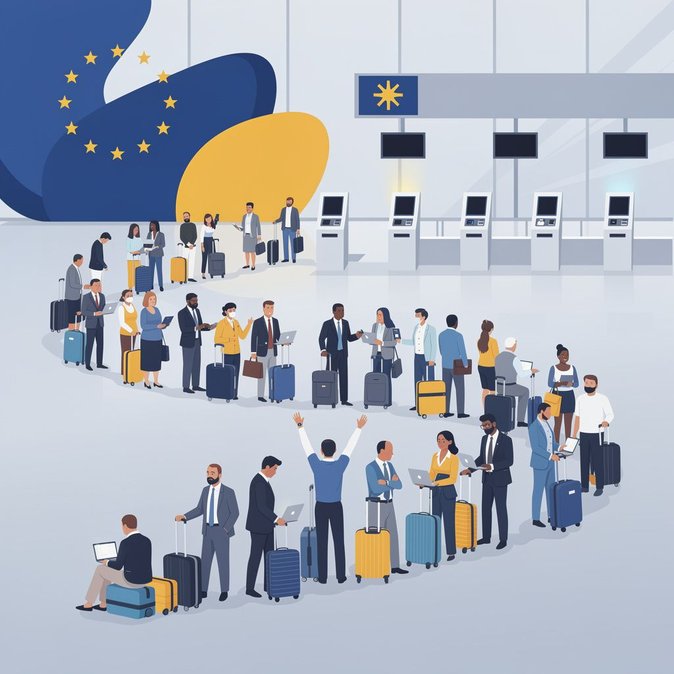
Passengers arriving at Brussels Airport on 30 September found themselves in lines stretching up to five hours after several automated border kiosks linked to the EU’s new Entry/Exit System (EES) crashed shortly after the morning rush. Airport staff handed out bottles of water and the quintessential Belgian speculoos biscuits to ease tempers, but social-media images of families sprawled on terminal floors quickly went viral. The EES, which became fully operational at Belgian border posts in April, was designed to replace manual passport stamping with a biometric scan of fingerprints and facial data for non-EU nationals. In theory the system should make crossings faster and allow authorities to spot visa-overstayers more easily. In practice, Brussels Airport has repeatedly struggled with staffing and hardware glitches. When the self-service kiosks are offline, all third-country travellers must funnel through the handful of manned booths, creating an immediate bottleneck. Airport management said extra Federal Police officers are being trained to bolster front-line capacity, but unions warn that at least 70 additional officers are needed before Christmas to avoid more meltdowns. The Interior Ministry has so far promised only 25 reinforcements. Industry groups such as IATA and Airlines for Europe are lobbying the European Commission to allow airports temporary flexibility—such as suspending fingerprint capture during peak hours—until infrastructure is upgraded. For corporate travel managers the incident is another reminder to build larger connection buffers into Belgian itineraries. Companies relocating staff or organising meetings in Brussels should advise non-EU assignees to allow at least three hours between landing and any onward commitments until the situation stabilises. Travel-risk providers also recommend pre-registering fingerprints at quieter regional airports where possible, although capacity there is limited. Beyond the immediate inconvenience, the episode highlights the broader challenge of harmonising high-tech border controls across 27 Member States with vastly different police staffing models and terminal layouts. If Belgium—home to one of Europe’s most modern hubs—cannot make EES work smoothly, smaller airports may face an even steeper learning curve.
Source: Zaventem.me / The Brussels Times