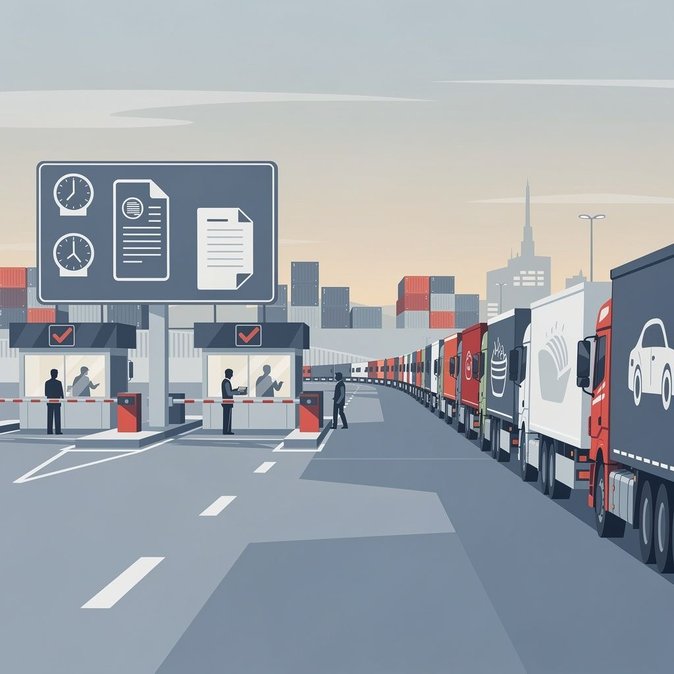
Live data from queue-monitoring portal KolejkaNaGranicy.pl at 19:21 Warsaw time on 4 October showed trucks waiting 88 hours and 25 minutes to enter Poland at Koroszczyn–Kozlovichi, the main freight crossing on the E30 corridor. South-bound traffic leaving Poland faced a modest 1 hour 55 minute delay, but east-bound congestion stretched a record 38 km. The jam follows Belarusian customs’ introduction—without prior notice—of 100 % document scans for EU-origin meat and dairy loads, part of Minsk’s ongoing “sanitary” retaliation against EU sanctions. Polish authorities redeployed 40 additional border-guard officers, yet processing stayed stuck at roughly 130 trucks per shift, far below the 310-vehicle design capacity. Late deliveries are rippling through supply chains: Tier-1 auto suppliers in Silesia have begun shipping via Lithuania’s Šalčininkai crossing despite a 260-km detour. Spot freight rates for refrigerated trailers on the Minsk-Warsaw lane have jumped 22 % since Friday, according to Trans.eu Marketplace. Shippers report that CEMT permits for alternate Ukrainian transits are nearly exhausted, a reminder to secure contingencies early. Companies should brief drivers on safe-parking locations—overnight temperatures near Brest are forecast to drop below 5 °C—and ensure that ATA carnets and veterinary certificates are pre-scanned to expedite checks. Logistics managers may also consider routing through the Poland–Lithuania corridor, where waits averaged just 27 minutes on 4 October. Longer term, Warsaw is lobbying Brussels for an EU-wide fast-laning mechanism when one member state’s border is deliberately slowed. Until then, businesses moving critical inputs via Belarus should budget at least four extra days of transit time and maintain real-time GPS visibility of high-value cargo.
Source: KolejkaNaGranicy.pl