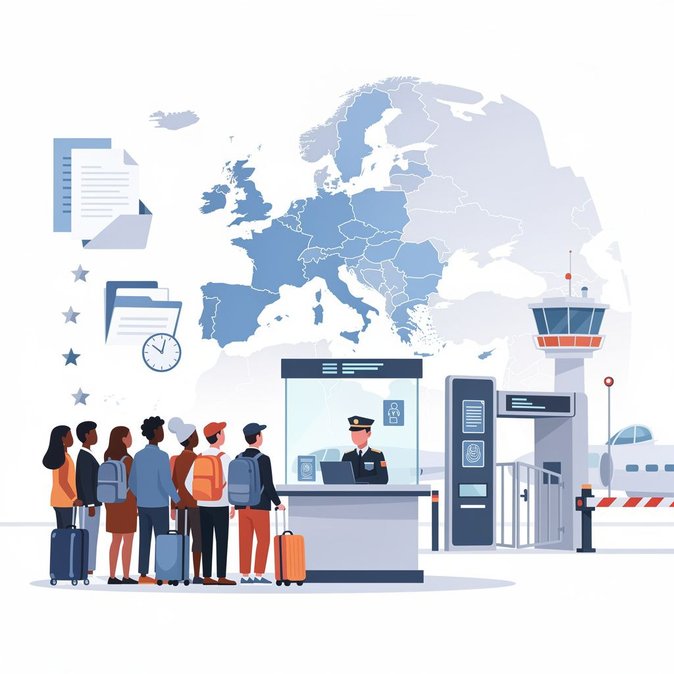
After almost six years of negotiation, the European Union’s Pact on Migration and Asylum officially entered into force on Friday, 12 June 2026. For France, this is more than an institutional milestone: it rewrites the rule-book that consulates, border police, human-resource desks and mobility managers have used for decades. Under the new regime every third-country national stopped at an external EU frontier – including Paris-Charles-de-Gaulle, the Channel ports and overseas airports such as Pointe-à-Pitre – must undergo a common screening covering identity, health and security. People coming from countries with average protection rates below 20 % can be channelled into an accelerated asylum procedure lasting a maximum of twelve weeks. Employers sponsoring talent visas will therefore see a clearer distinction between labour-migration routes and humanitarian channels, but they will also face tighter deadlines to produce documentation if an employee’s nationality falls under the accelerated track. A second pillar is a permanent “solidarity mechanism”. France, which received 137 000 first-time asylum applications last year, is classified as a country under migratory pressure. Other member states can choose either to relocate asylum-seekers to their own territory or to pay a financial contribution; Paris estimates that the solidarity pool could fund 6 000 extra reception places in 2026. Business-travel planners should nevertheless expect occasional capacity crunches in the Paris and Lyon regions, where accommodation is already tight. Finally, the pact is mirrored in domestic law. A decree published on 6 June amended the Code de l’entrée et du séjour des étrangers et du droit d’asile (Ceseda), allowing French officials to collect full sets of fingerprints from applicants aged six and above and to link visas directly to the EU’s Entry/Exit System. The Interior Ministry confirmed that border guards have completed software upgrades at Roissy and Orly and have trained 1 200 staff on the new tablets used for biometric filtering. For multinationals, the practical advice is twofold: 1) build a one-page briefing for internationally-mobile staff explaining that queues may lengthen during the first weeks of the rollout, particularly for non-EU passport-holders; 2) review posted-worker files, because the new Return Regulation (expected to be adopted later this month) will make it harder to regularise staff who overstay their permits. In short, compliance is now a moving target – but one with clearer, EU-wide coordinates.
Source: Europe 1 / Brussels Signal