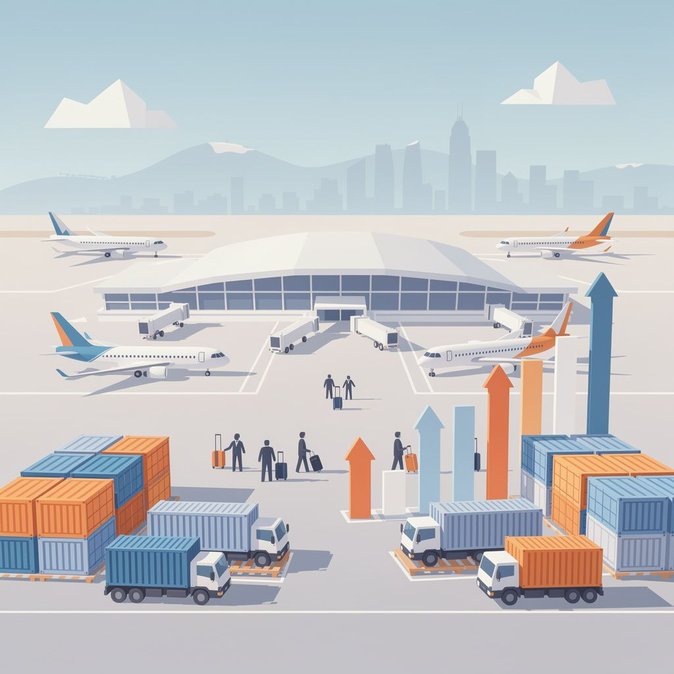
Airport Authority Hong Kong (AAHK) published its latest traffic bulletin on 20 July 2026, confirming that Hong Kong International Airport (HKIA) is consolidating its post-pandemic rebound. The airport handled 5.12 million passengers in June—up 7.9 % year-on-year—while flight movements rose 2.3 % to 31,940. Transfer and transit traffic provided the biggest boost, especially on Northeast Asian routes to Japan and high-frequency services to Mainland China. In the first six months of 2026, passenger throughput climbed 11.7 % to 32.8 million and flight movements increased 4.4 % to 200,685, underpinned by the full commissioning of HKIA’s Three-Runway System last November and the resumption of additional Cathay Pacific and Greater Bay Airlines frequencies. Cargo is also recovering: total tonnage grew 4.1 % to 2.5 million tonnes in H1, helped by a 19.5 % surge in trans-shipment volumes as electronics manufacturers diverted freight flows through Hong Kong to avoid congestion elsewhere in the region. AAHK highlighted that HKIA’s innovation drive is winning international plaudits. In June the airport was named “Airport of the Year – Major Cargo Hub” at the World Air Cargo Awards for the second consecutive year, and received the “Air Cargo Innovation Award” for its SmartCollect import initiative, which uses IoT sensors and blockchain documentation to shorten cargo dwell time. HKIA was also voted “Best Global Airport” for the 11th straight year in Asia Cargo News’ AFLAS awards. For corporate mobility managers, the figures signal a return to more reliable lift out of Hong Kong ahead of the summer peak: seat capacity on regional routes is now at 93 % of 2019 levels, and AAHK expects to breach the 70 million-passenger mark on a rolling 12-month basis by December. Companies moving staff or freight through Hong Kong should, however, plan for higher passenger volumes at security checkpoints and renewed competition for belly-hold cargo space. AAHK’s Director of Hub Development, Chapman Fong, reiterated the authority’s focus on “high-value, time-critical logistics” and announced that a pilot paper-free customs corridor with the Guangdong-Hong Kong-Macao Greater Bay Area will launch in Q4. If successful, the scheme will allow trucks to clear mainland and Hong Kong customs in a single transaction, potentially shaving four hours off end-to-end delivery times for electronics exports.
Source: Airport Authority Hong Kong