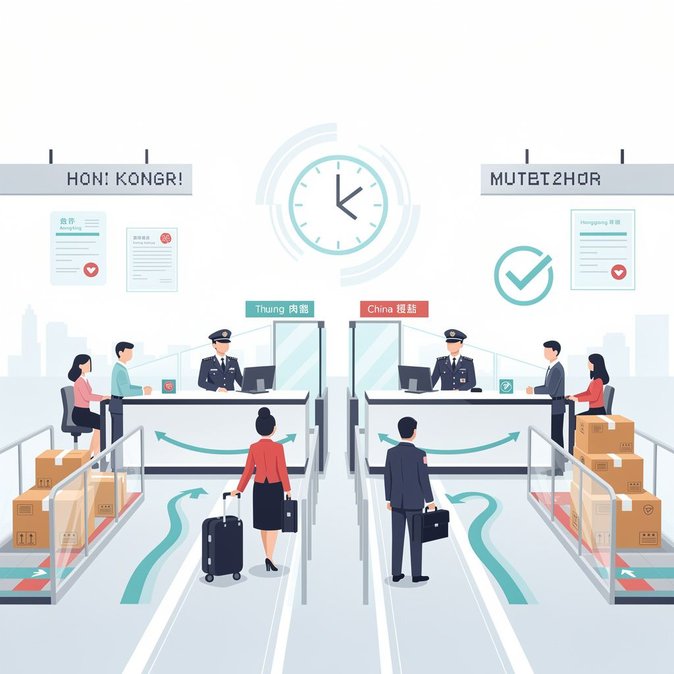
Hong Kong’s Legislative Council raced through all remaining stages of the Huanggang Port Hong Kong Port Area Bill on Friday, July 17, clearing the final legal hurdle for the city’s first fully “co-located” land boundary checkpoint with mainland China. Under the new ordinance, a dedicated Hong Kong Port Area (HKPA) will be carved out inside the redeveloped Huanggang terminal building in Shenzhen, allowing officers from both sides to operate under their respective jurisdictions inside the same hall. The arrangement will replace today’s two-stop system—where travellers clear Hong Kong formalities before boarding a shuttle across the river to clear mainland immigration—with a single, joint-clearance process. Security Secretary Chris Tang told lawmakers that average clearance times should fall from about 30 minutes to “as little as five minutes”, thanks to shared facilities, facial-recognition e-lanes and real-time data links. Co-location has been used at the West Kowloon high-speed rail terminus since 2018, but Huanggang will be the first land crossing to adopt the model. The bill was tabled only three days earlier and passed after a four-hour special sitting, making it one of the fastest pieces of border legislation since the 2021 overhaul of Legco’s rules. Mainland authorities have already completed the bulk of construction work on the new 24-hour terminal, which will handle an expected 200,000 passenger journeys a day once it opens on July 31. Hong Kong will retain full criminal and civil jurisdiction inside the HKPA, while Shenzhen police will patrol the surrounding mainland zone. For cross-border commuters, the upgrade promises shorter queues, more frequent 24-seat minibuses into the New Territories, and a purpose-built public-transport interchange that will consolidate franchised buses, green minibuses and long-haul coaches. Logistics companies also expect faster customs clearance for high-value cargo shipped by road between the two Greater Bay Area hubs. However, some local lawyers have urged the government to publish clear procedures for handling incidents that start in one zone and spill into the other, to avoid jurisdictional confusion. With Huanggang set to become the blueprint for future Guangdong-Hong Kong land crossings, city planners are already looking at whether a similar one-stop model could be retrofitted to busy checkpoints such as Lok Ma Chau and Shenzhen Bay. For multinationals running shuttle services for staff between Hong Kong’s finance centre and Shenzhen’s tech parks, Friday’s vote signals a coming era of friction-free daily commuting across the border.
Source: South China Morning Post