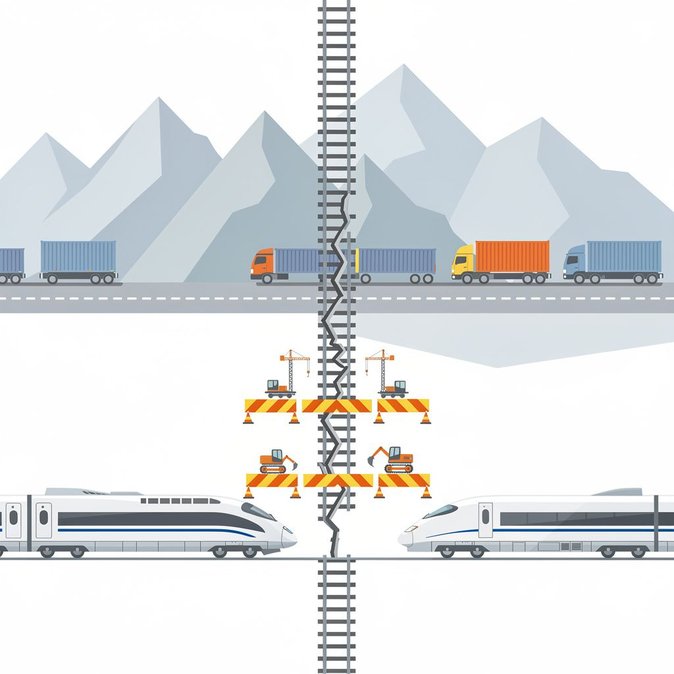
Cross-border rail mobility between Italy, Austria and Germany will take a significant hit from today, 23 July 2026, as the second phase of a major upgrade to the Brenner railway line comes into force. Austrian Infrastructure Agency ÖBB has closed the section between Steinach am Brenner and Innsbruck until 1 August, while Italy’s Rete Ferroviaria Italiana (RFI) continues works on the Bressanone–Brennero stretch. Combined with earlier closures farther south, the move effectively severs the principal north-south rail artery that carries both high-speed passenger services and a large share of Italy’s north-bound freight. During the nine-day blockade, long-distance EuroCity, Railjet and Nightjet trains that normally run Milan / Venice–Verona–Bolzano–Innsbruck–Munich are terminating in Bolzano or, in some cases, Verona. Regional services in South Tyrol and Tyrol are replaced by limited bus shuttles, but bicycles and oversized luggage cannot be carried. Logistic companies have been advised to divert containers via the Tarvisio route (Udine–Villach) or switch to road haulage through the Brenner motorway, where congestion is already heavy due to holiday traffic and weekend truck bans. For mobile employees and assignees in Italy’s export-heavy north-east, the closure may mean rerouting via flights from Verona or Venice, adding cost and carbon impact. Employers should update travel policies to reflect longer journey times and ensure posted workers travelling from Germany or Austria to Italian sites hold valid Schengen multi-entry visas, as replacement buses may cross borders multiple times. The Brenner project, valued at €1.5 billion, aims to modernise signalling and create capacity for the 64-km Brenner Base Tunnel, now scheduled to open in 2030. Today’s closure is the most disruptive phase to date and provides a stress-test for future tunnel integration. Mobility managers should therefore treat this as a rehearsal and collect data on employee displacement costs and alternative routing efficiency. RFI and ÖBB have promised daily status updates, but travellers are urged to check real-time information and reserve bus seats where possible. Ticket refunds or re-booking are offered without penalties; however, guaranteed-service rules that apply in strikes do not cover planned works, so compensation is limited.
Source: Südtirolmobil & RFI