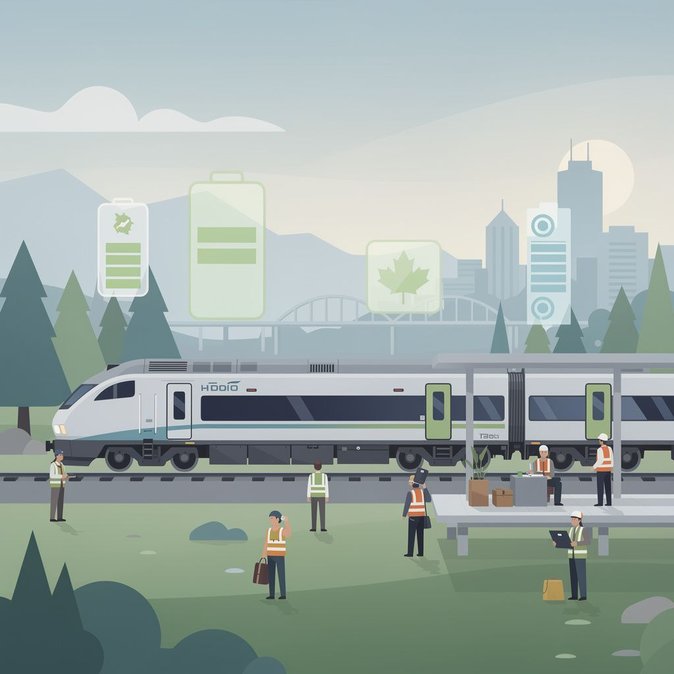
In the biggest rolling-stock procurement Canada has seen in decades, Transport Minister Steven MacKinnon announced on July 29 that Ottawa will spend $1.95 billion to replace VIA Rail’s aging long-distance, regional and remote-service locomotive fleet—and to assemble most of the new equipment on Canadian soil. The contract awards Swiss manufacturer Stadler up to 45 battery-diesel hybrid locomotives. While the frames and traction equipment will be built at Stadler’s Spanish plant, final assembly for as many as 36 units will take place in a purpose-built facility at VIA Rail’s Montréal maintenance centre, re-establishing domestic passenger-locomotive production for the first time in a quarter-century. Hybridisation matters for mobility managers. The locomotives will switch automatically between conventional diesel and battery power, cutting fuel burn on station approaches and in tunnels, reducing greenhouse-gas emissions by 15-20 % and noise by up to 30 %. Battery packs will be supplied by ABB from its Saint-Laurent plant, anchoring a Canadian supply chain that Ottawa says will support the equivalent of 1,200 full-time jobs during construction and maintenance. For global-mobility teams moving staff or goods across Canada, the upgrade promises more reliable schedules on iconic routes such as the trans-continental Canadian and the Ocean in the Maritimes—services that corporations often use to reposition crews or move time-sensitive cargo when winter weather grounds flights. The new power will be compatible with higher speeds once track owners grant slots, shaving hours off current journey times and giving business travellers a lower-carbon alternative to short-haul flights. Procurement rules require Stadler to maximise Canadian content; early estimates put the local spend at nearly $700 million. That will benefit a network of suppliers in Québec and Ontario—from wiring harnesses to control software—while creating a domestic skills pipeline for future high-speed-rail projects in the Québec City–Windsor corridor. The first locomotive is due to roll off the Montréal line in 2028, with the fleet entering service by 2029. Until then, VIA Rail will continue to refurbish its 30-year-old F40 and 1950s-era Budd equipment—an operational headache that has forced schedule padding and occasional cancellations. Corporations arranging employee relocations or assignment travel should factor in a gradual improvement in on-time performance from 2029 onward, and may wish to revise internal travel policies to encourage use of the cleaner rail option once reliability targets are met.
Source: Transport Canada