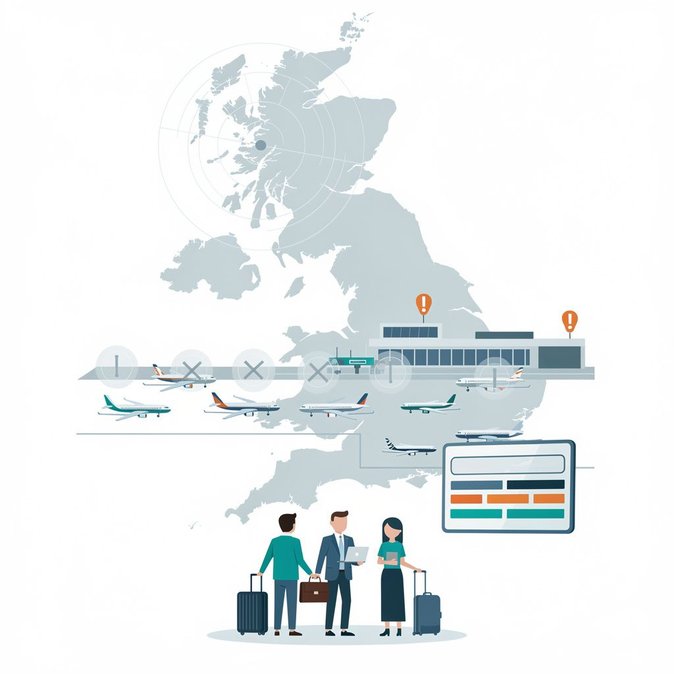
Passengers flying to or from Scotland, Northern Ireland and the north of England faced a brutal bout of déjà-vu on Monday, 21 September, when the U.K.’s air-traffic-control provider NATS suffered its second major technical failure in as many weeks. The latest outage, traced to the Prestwick control centre, triggered immediate traffic-flow restrictions that forced airlines to cancel at least 227 flights and delay hundreds more. Business-critical routes from Manchester, Edinburgh and Belfast were worst hit, while London airports remained largely unaffected. Although NATS restored the system within hours, the operational hang-over is expected to linger for at least 24 hours as airlines try to reposition aircraft and crew. Aviation analytics firm Cirium estimates the direct cost to carriers at more than £12 million in aircraft, crew and passenger-care expenses, not counting downstream schedule knock-ons. Corporate travel managers are urgently rerouting executives, and mobility teams report surging demand for rail tickets and short-haul car hires as travellers scramble for alternatives. The incident compounds reputational pressure on NATS chief executive Martin Rolfe, who is already under fire after a 9 September software defect led to the cancellation of 2,000 flights nationwide. Both the Board of Airline Representatives in the U.K. (BAR UK) and low-cost giant Ryanair repeated calls for an independent review—and, in Ryanair’s case, for Rolfe to resign. For global-mobility programmes, the double failure is a stark reminder of the fragility of a single-point-of-failure ATM model. Companies with time-sensitive assignments in energy, defence and life-sciences clusters around Aberdeen and Teesside should revisit contingency plans, including negotiated ‘last-seat’ rail fares and flexible accommodation blocks. NATS says it is “working with airports and airlines to safely lift air-traffic regulations as quickly as possible,” but pressure is mounting for accelerated delivery of the agency’s delayed £1 billion air-space modernisation roadmap. Until then, corporate travellers may need to budget extra slack—both temporal and financial—into their northern U.K. itineraries.
Source: Associated Press