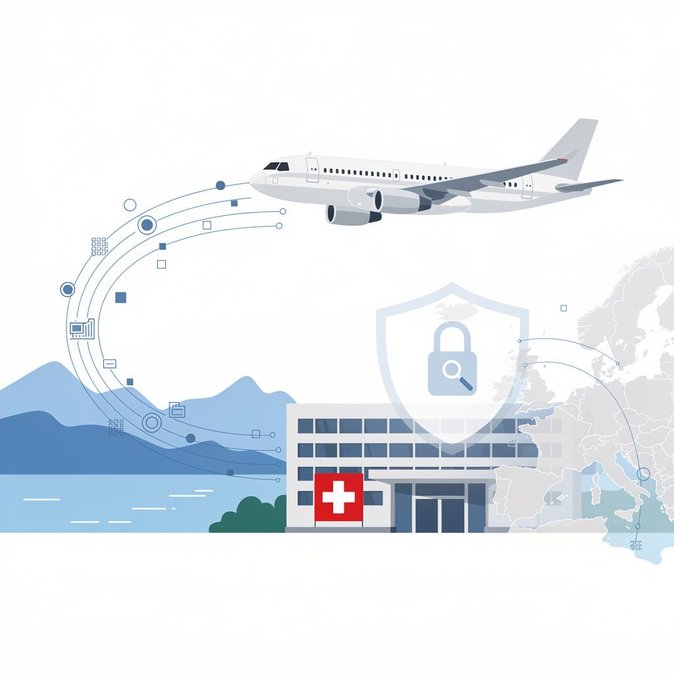
The Swiss Federal Council has confirmed that its long-awaited Passenger Name Record (PNR) regime will go live on 1 November 2026, giving authorities three months to complete technical and staffing preparations before systematic collection of airline passenger data begins on 1 February 2027. Under the new system, airlines operating to Swiss airports must transmit travellers’ reservation details—including itinerary, contact data, payment information and baggage references—to a newly created Passenger Information Unit (PIU) housed within the Federal Office of Police (fedpol). PNR data will be screened against watch-lists, analysed for behavioural risk patterns and retained for up to five years, in line with EU best practice. Switzerland is one of the last Schengen partners to implement PNR and has needed bespoke legislation because it is not an EU Member State. Parliament approved the legal basis in March 2025; a referendum challenge failed to materialise, clearing the way for the Federal Council to set the commencement date at its 18 September 2026 meeting. According to the government, the PIU will start with eight specialists working limited hours but will expand to 14 posts in 2028 and up to 30 by 2030 as airlines are phased into mandatory, near-real-time data transfers. Eight other federal ordinances—including those governing the VIS visa system, RIPOL police database and the national segment of the Schengen Information System—have been amended to ensure seamless sharing of data across Swiss, EU and international law-enforcement platforms. For corporations and frequent flyers the immediate impact will be largely invisible: no new forms or advance approvals will be required, and tickets can still be booked as usual. However, travel managers should update privacy notices to reflect the fact that Switzerland will soon process the same PNR dataset already collected by many EU states, the United States and Canada. Carriers that have not yet integrated their messaging formats (EDIFACT or XML) with fedpol’s secure gateway have less than a year to comply. Failure to transmit accurate data could trigger fines of up to CHF 500,000 per offence. Strategically, the move bolsters Switzerland’s standing inside the Schengen area at a time when some EU capitals are questioning free movement amid security concerns. By aligning with the bloc’s counter-terrorism toolbox, Bern hopes to minimise pressure for new internal border checks and to reassure neighbours that Swiss airports will no longer be a blind spot in Europe’s passenger-data net.