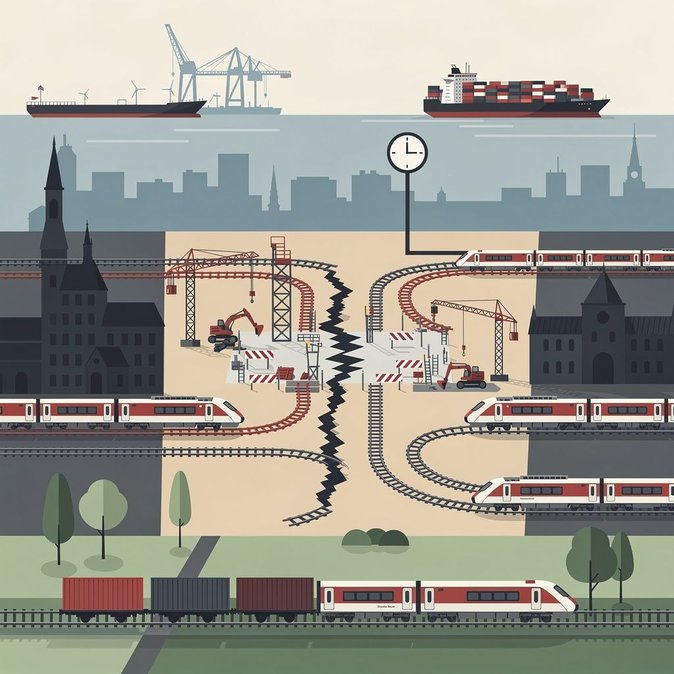
Deutsche Bahn (DB) switched off two key suburban rail arteries in northern Germany at 00:00 on 3 October 2026, kicking off a 16-day blockade needed to connect the future S4 (Ost) rapid-transit line. Tracks 1120 (Hamburg-Berliner Tor–Hamburg-Rahlstedt) and 1242 (Abzweig Horn–Hamburg-Wandsbek) are now out of service until 04:00 on 19 October. Passenger services between Hamburg and Lübeck are being rerouted via Büchen, adding up to 25 minutes per journey, while most regional expresses terminate short of the works. DB InfraGO, the infrastructure arm created in January, has issued an extraordinary compensation scheme for freight operators. Diesel-hauled detours via Lübeck–Büchen–Lüneburg and alternative lines toward Maschen or Neumünster will attract flat-rate payments of €1 828–2 603 per train, provided operators submit distance proofs and invoices by 30 November. The gesture acknowledges the cost of diverting locomotives away from Hamburg’s electrified trunk route. For commuters the biggest pain point is the absence of through S-Bahn services to Hamburg’s eastern suburbs. Replacement buses run every ten minutes during the morning peak but journey planners already flag at-seat times of 70-90 minutes from Bargteheide to the city centre—double the usual. Business travellers landing at Hamburg Airport and heading to firms in Lübeck or the Baltic ferry ports should factor in longer rail or road transfers. The S4 (Ost) project, co-funded by the federal and Schleswig-Holstein governments, will ultimately create a dedicated rapid-transit link from Hamburg Hauptbahnhof to Bad Oldesloe, freeing capacity on one of Germany’s busiest mixed-traffic corridors. DB says the long blockade is the only way to install turnouts and signalling without years of overnight or weekend closures. A second total shutdown is pencilled in for Easter 2027.
Source: DB InfraGO customer bulletin