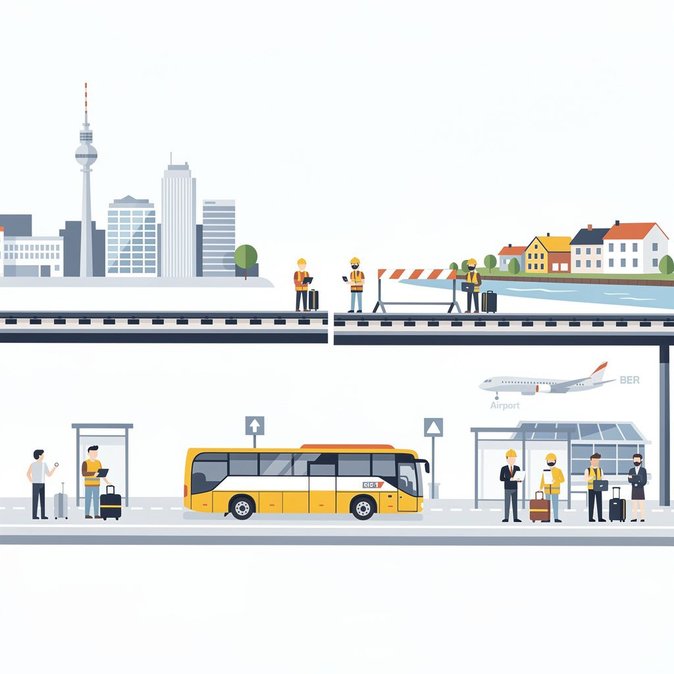
Travellers between the German capital and Poland’s border region woke up on Monday to a very different commute. Overnight, state rail operator ODEG closed the busy RE1 corridor between Berlin Ostbahnhof and Frankfurt (Oder) for track modernisation, halting both regional and EuroCity services until 15 August. In a bid to keep the business artery alive, transport authorities have deployed a two-tier replacement network: all-stops shuttle buses for local users and a non-stop Expressbus that races along the A12 motorway from Berlin Brandenburg Airport (BER) to Frankfurt (Oder). The express service operates with twin coaches in peak hours, offering luggage racks and Wi-Fi aimed at commuters and air passengers alike. Journey time is only 20 minutes longer than the usual 1 h 10 min rail trip, according to operators interviewed by Tagesschau on 27 July. Early feedback is positive—seat availability has remained high even on Monday morning’s 07:00 departure—but many cross-border workers still face longer days and revised shift patterns. Business continuity, not comfort, is the chief goal. The RE1 line moves roughly 40,000 passengers a day, including Polish software engineers working at Berlin tech hubs and German managers overseeing investments in Świecko’s logistics parks. EuroCity trains to Warsaw, Gdańsk and Kraków are also rerouted onto buses, creating knock-on effects for international travellers holding Interrail and DB Global Flex tickets. Airlines using BER, meanwhile, are bracing for more passengers arriving by road, prompting the airport to add signage and extend kerbside drop-off times. The shutdown forms part of Germany’s decade-long “Korridor-Programm”, which rebuilds high-traffic rail corridors in one intensive block instead of years of weekend closures. Officials argue that the long-term reward—higher speeds, a denser 20-minute RE1 interval and full European Train Control System (ETCS) signalling—will outweigh this summer’s disruption. For now, mobility managers should alert assignees that the only rail-free crossing between Berlin and Poland with through-ticket recognition is via Cottbus and the RB 36, a diversion that adds nearly 90 minutes.
Source: Tagesschau