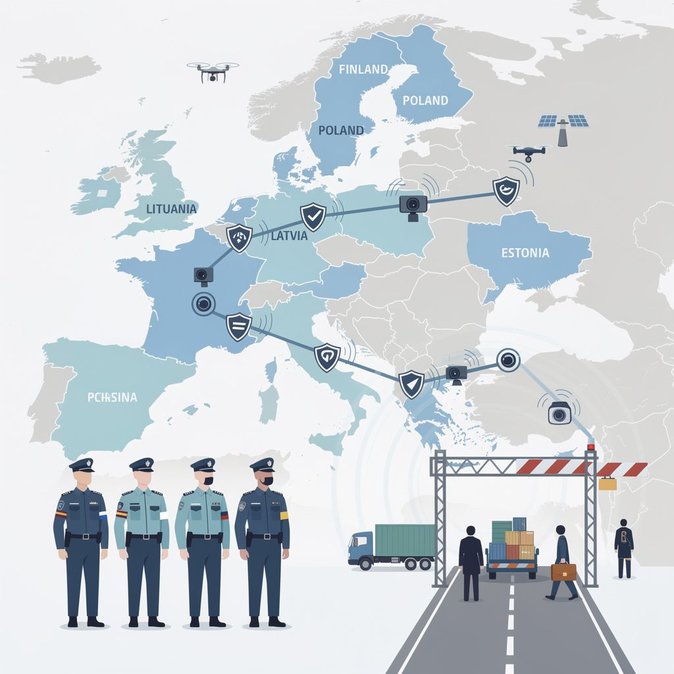
Senior officials from the Finnish Border Guard hosted their counterparts from Poland, Latvia, Lithuania and Estonia in Helsinki on 30 September–1 October, with the communique released on 5 October. The two-day gathering focused on the sharp rise in hybrid security threats and irregular migration pressure along the eastern flank of the European Union. According to the Polish Border Guard’s statement, the delegations compared intelligence on human-smuggling routes, drone incursions and the upcoming Schengen Entry/Exit System (EES) that is due to go live across the bloc in 2027. Finland’s hosts briefed partners on the barriers erected on the Russian frontier and on the legal tools adopted since 2024 that allow temporary closure of crossing points in emergencies. All five services agreed to rehearse joint contingency plans this winter, including the rapid deployment of mobile patrol units and the sharing of aerial-surveillance assets. They also endorsed closer co-operation with Frontex and called for faster EU funding to reinforce land crossings and maritime detection technology. For Finnish corporates that send staff or goods through the eastern border, the meeting signals that spot checks and temporary closures could remain common in the coming months. Logistics managers were advised to build extra lead time into supply chains and to monitor real-time alerts from the Border Guard’s RAJA App. Business travellers arriving from Russia or Belarus may also face longer screening as pilot biometric kiosks for EES are installed at Vaalimaa and Nuijamaa. Experts note that the Nordic-Baltic platform is becoming an influential sub-regional forum inside Schengen. "We are talking about an operational coalition that can move faster than Brussels when threats evolve overnight," said Dr Heli Salonen of the University of Lapland’s Arctic Security Programme. Companies employing third-country nationals should therefore expect rule changes—such as extended carrier-liability fines or new pre-arrival data sets—to be coordinated across the five states rather than introduced unilaterally. In the final press briefing, the chiefs confirmed their next meeting will take place in Warsaw in spring 2027, by when the group aims to have a joint risk-assessment dashboard in production and a harmonised protocol for drone interception along the Baltic Sea ferry corridors.