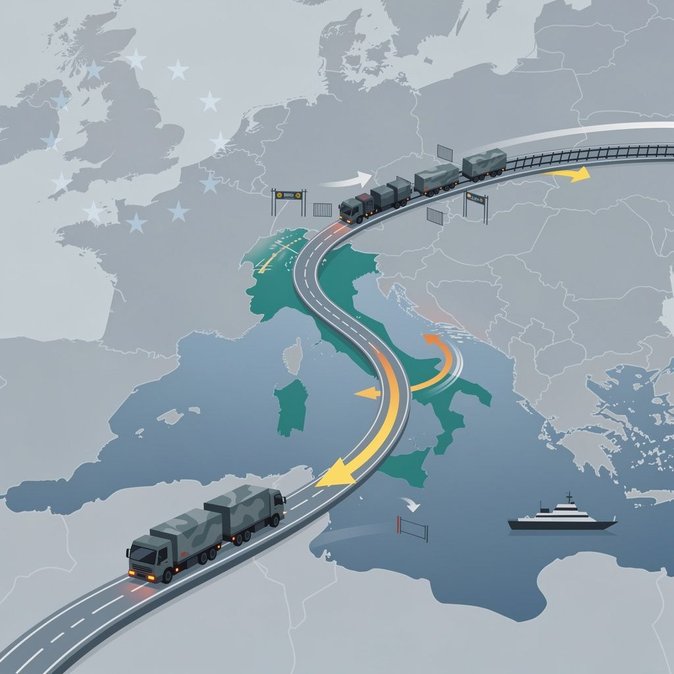
Speaking at a conference in Hamburg on 7 October, European Defence Commissioner Andrius Kubilius called on the European Parliament and Council to finalise the long-awaited ‘Military Schengen’ Regulation, warning that Russia’s 2027 defence budget could exceed the combined spending of all EU member states. The proposal would replace 27 national permit regimes with a single EU framework allowing troops and equipment to cross borders within 24 hours. For Italy, positioned at the centre of NATO’s southern corridor, the regulation would streamline the movement of allied forces through ports such as Genoa, Taranto and Trieste and across Alpine road and rail tunnels to Central Europe. Italian freight forwarders handling dual-use cargo expect a 30 % reduction in paperwork once the regulation is in force, according to the Milan-based Transport and Logistics Association. The draft text—currently in trilogue—requires member states to designate ‘military mobility corridors’ that overlap with the TEN-T network. Italy has already flagged the Brenner and Tarvisio rail routes, the A1 and A14 motorways and key airports (Pratica di Mare, Pisa, Aviano) as priority axes, pledging to adapt bridges and customs facilities to NATO weight standards by 2028. Although primarily a defence file, the regulation will also affect commercial global-mobility programmes: convoys would receive priority slots on road and rail, potentially creating temporary capacity constraints for civilian supply chains. HR and travel managers should monitor implementation timelines, as future ‘green lanes’ for military cargo could trigger ad-hoc reroutings or curfews similar to those seen during large-scale exercises such as Defender Europe.
Source: Eunews