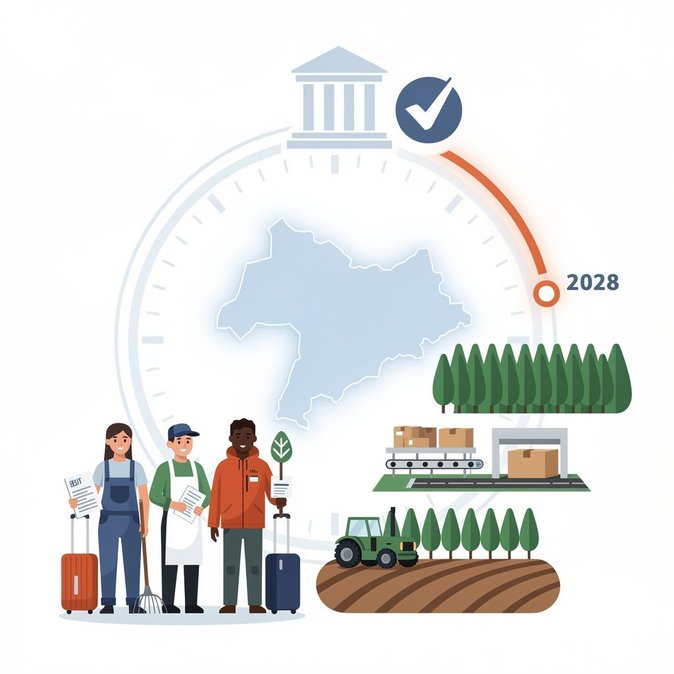
The Czech government has quietly but decisively moved to shore up its tight labour market by approving another two-year extension of its special work-visa scheme for low-skilled foreign labour. According to the resolution adopted at the cabinet meeting of 19 October and published on 21 October 2026, the programme—originally launched as an emergency measure in 2019—will now run until 31 December 2028. The visa track targets persistent shortages in agriculture, food processing and forestry. Employers enrolled in the programme can recruit nationals of Ukraine, Georgia, Bosnia-and-Herzegovina, Moldova and North Macedonia for contracts of up to 12 months. The annual quota remains capped at 2 500 permits, of which 1 500 are reserved for Ukrainians and 1 000 shared by the remaining four countries. While the visas cannot be prolonged, workers may re-apply after leaving the country, maintaining a legal pipeline of seasonal labour without creating long-term immigration backlogs. Industry groups such as the Agrarian Chamber estimate Czech farms are currently short of some 5 000 hands—roughly 6 % of the sector’s workforce. By locking in an additional two years of access to vetted migrant labour, the Ministry of Agriculture hopes to protect food-production capacity while a broader overhaul of the Foreign Nationals’ Residence Act is finalised for 2029. The measure also buys time for a planned rollout of the EU-wide Entry/Exit System (EES) and ETIAS travel authorisation, both expected to complicate short-stay recruitment workflows. For employers, the decision provides welcome certainty ahead of the 2027 and 2028 planting seasons. Companies must remain registered in the scheme and may not use staffing agencies as official employers; however, the government has promised to streamline document processing at consulates in Kyiv, Tbilisi and Skopje and to pilot batch submissions to cut lead-times below the current eight-week average. HR managers should therefore review head-count projections and lodge reservation requests early—the quota has filled within weeks in each of the past three years. Prospective applicants should note that the visa still limits residence to one year and offers no direct path to permanent status. Nonetheless, the move signals Prague’s continued willingness to use bespoke visa instruments to fine-tune labour supply rather than resorting to costly subsidies or automation grants. For global-mobility teams, it underscores the importance of monitoring niche national schemes, even inside the Schengen Area, as Europe’s demographic crunch deepens.
Source: Expats.cz / 420on.cz