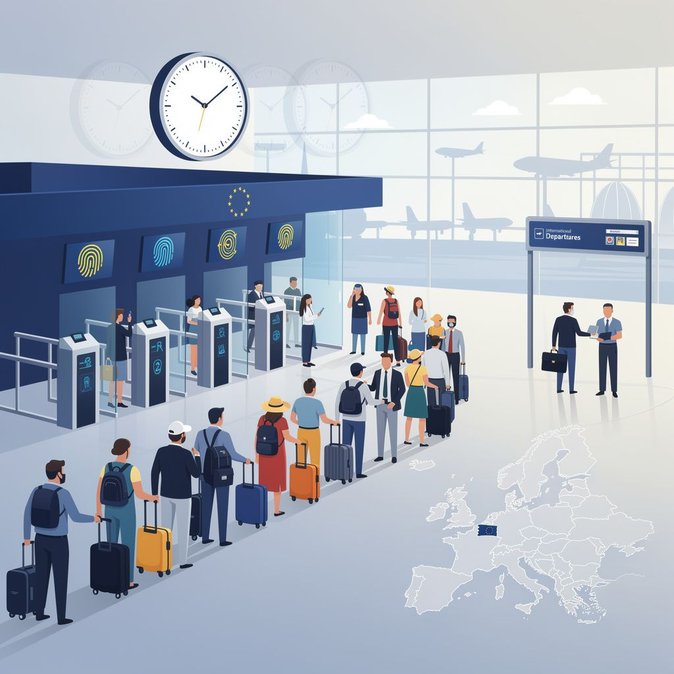
European airlines and airport operators have issued an open letter to Commission President Ursula von der Leyen warning that the newly-launched Entry-Exit System (EES) risks bringing major hubs – including Frankfurt, Munich and Düsseldorf – to a standstill during the peak summer rush. In the letter, seen by The Brussels Times, industry body ACI Europe says biometric registration bottlenecks are already generating queues of up to five hours for non-EU travellers. The coalition is calling for a temporary ‘switch-off’ of the system between now and 1 September. Germany is among the states most exposed. Since April, all third-country nationals entering a Schengen airport must provide fingerprints and a live facial scan, a process that takes 60–90 seconds per person even when kiosks are fully functional. Frankfurt Airport handled 4.9 million extra-Schengen passengers last August; at that throughput, a one-minute delay per traveller would translate into 82,000 lost processing minutes – equivalent to shutting two full e-gates for an entire day. The aviation sector argues that staffing cannot simply be ramped up. Under German law, federal police are solely responsible for border control, and a post-pandemic recruitment drive has not kept pace with attrition. Carriers also fear that missed connections could trigger compensation claims under EU 261, adding millions of euros in potential liability at a time when margins are already thin due to fuel prices. The Commission has replied that “flexibility measures” exist, including the option to defer biometric enrollment if queues exceed certain thresholds, but it stopped short of approving a blanket suspension. Berlin privately supports a targeted derogation; Interior Minister Alexander Dobrindt told reporters last week that Germany “will not compromise passenger security” but is “open to pragmatic queue-reduction steps”. For corporate mobility leaders the message is clear: advise travelling staff to arrive at least three hours before departure on extra-Schengen flights, pre-register passport data where airlines offer advance EES capture, and monitor airport-specific mitigation measures such as dedicated business-class lanes that some hubs are piloting. Companies with tight project timelines should factor potential half-day delays into scheduling and consider connecting via EU airports where EES kiosks are less saturated.
Source: The Brussels Times