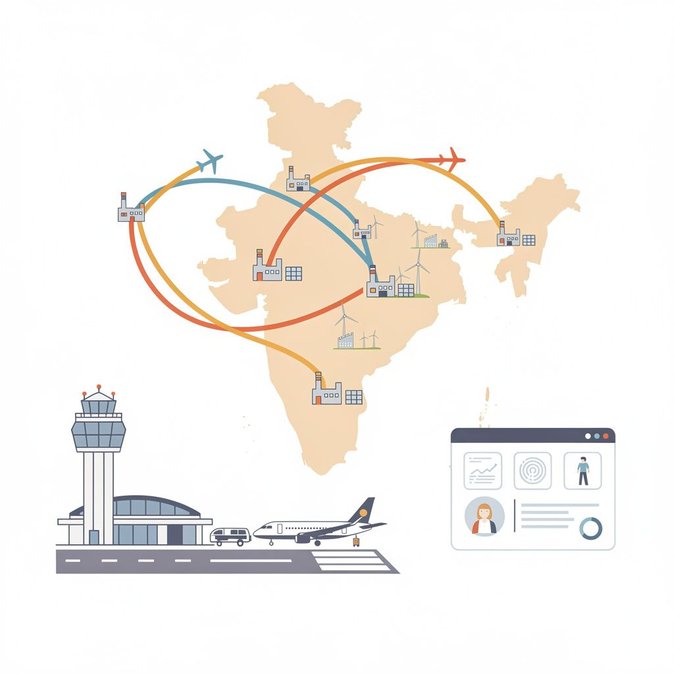
The Ministry of Civil Aviation on 22 September inked 21 memoranda of understanding with state governments and the Airports Authority of India to launch the ‘Modified UDAN’ phase of its flagship regional-air connectivity scheme. Since 2017, UDAN has activated 687 routes and 95 airports, carrying 17.1 million passengers. The refreshed blueprint aims to add 120 new destinations—including heliports and water aerodromes—and four crore additional passengers over the next decade. Key pillars include a Challenge-Mode portal through which states can nominate airstrips, new viability-gap funding formulas to ensure operator profitability, and incentives for indigenous aircraft manufacturing. Civil Aviation Minister Naidu said employment in aviation has already doubled to 7.7 million and could hit 25 million by 2040 if regional demand matures as projected. For global-mobility teams, UDAN’s expansion can slash door-to-door times for staff posted at manufacturing clusters like Purnea (Bihar) or Tezu (Arunachal Pradesh), which currently require arduous road legs to reach a hub airport. Airlines are expected to release route bids next month; companies planning green-field plants should monitor which Tier-III cities secure service. However, infrastructure remains a hurdle. Several UDAN airports lack night-landing or instrument-landing systems, limiting reliability during monsoon months. The ministry said AAI will fast-track CAT-I lighting and GNSS approaches at priority airfields, but timelines remain vague. Travel-policy implication: organisations may soon have to decide whether to reimburse employees for on-demand air taxis or helicopter links that fall outside standard fare caps, as Modified UDAN explicitly supports rotorcraft.
Source: The Economic Times