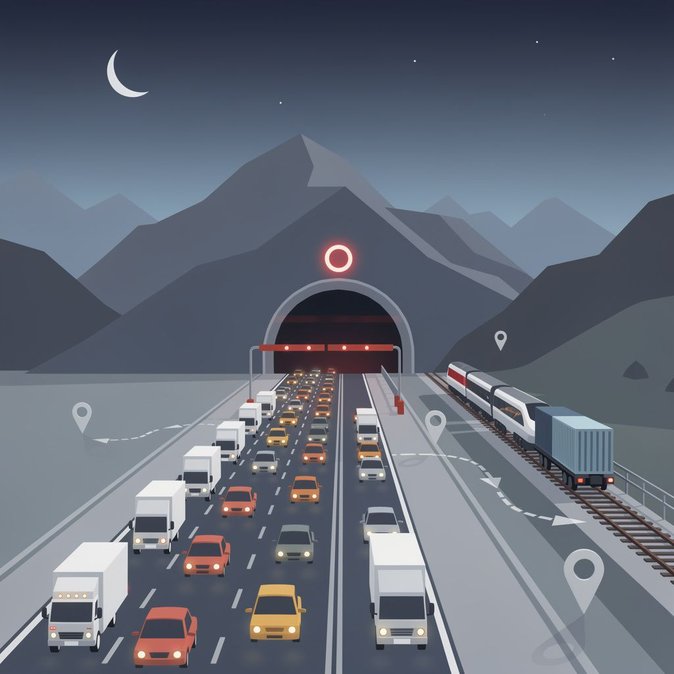
Drivers and road-haulage operators heading through the Alps this week are being urged to re-route or build in generous buffers after the Federal Roads Office (Astra) began a three-night, 20:00-05:00 closure of the 17-km Gotthard road tunnel for scheduled maintenance. Traffic data collected overnight from 28 to 29 September already show tailbacks of more than seven kilometres on the A2 approach, with waiting times exceeding 90 minutes at the evening peak, according to live monitoring by the Touring Club Suisse and real-time updates published by Reisereporter. The Gotthard is Europe’s busiest north-south road artery, funnelling up to 17,000 vehicles a day, including a high proportion of just-in-time freight between Germany and Italy. With only one lane per direction inside the tunnel, closures inevitably force heavy goods vehicles and holiday traffic onto the Gotthard Pass or the San Bernardino route, both of which add at least an hour – and bad-weather risk – to the journey. Astra has warned that exceptional-load transports wider than 5.2 metres will be denied passage until 05:00 on 30 September. Tour operators and corporates moving workers between Switzerland, northern Italy and southern Germany are advising staff to fly or use the rail base tunnel, where passenger services are running normally. However, logistics firms say spare capacity on the Swiss Federal Railways (SBB) rolling-highway service is limited and booking windows have closed for most slots this week. The night closures are part of a wider programme of 34 nighttime shutdowns in 2026 linked to construction of the second tunnel tube, due to open in 2030. Practically, companies should update driver briefings daily, consider staging trucks at Basel or Milan to avoid the evening rush, and remind mobile workers that expense claims will be scrutinised if they ignore official detours. Astra is also recommending that passenger cars heading south postpone departure until after 22:00 or leave before 17:00 to dodge the heaviest congestion. Failure to plan could see journey times double and delivery schedules miss SLA targets, with knock-on effects across just-in-time supply chains stretching from the Benelux to Lombardy. From a policy perspective the episode underlines the fragility of a corridor that carries nearly a third of Swiss foreign trade by value. Business lobbies are again calling on Bern to accelerate rail-freight incentives and the rollout of dynamic speed limits north of Lucerne to smooth traffic peaks. While the nightly works will finish on 30 September, further closures are scheduled for early October, making proactive travel management essential for the rest of the autumn holiday season.
Source: Reisereporter / RND