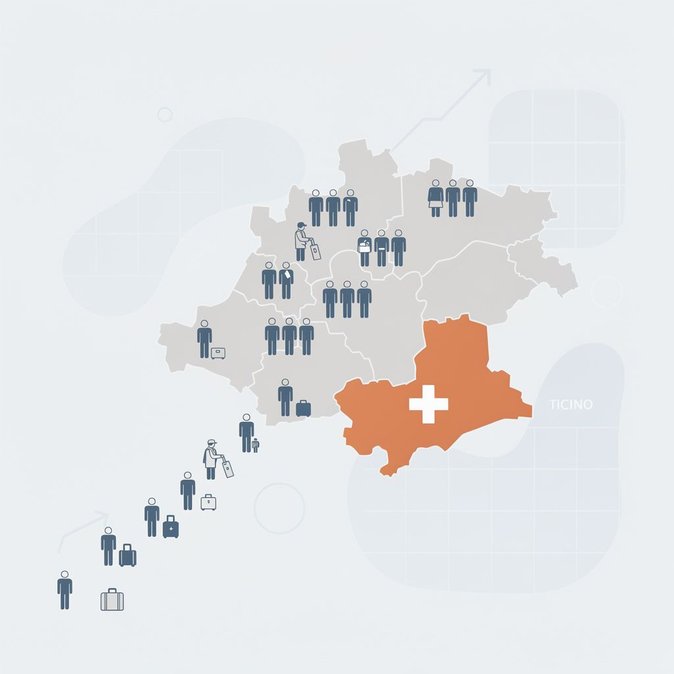
Fresh figures released on 22 July 2026 reveal a cooling labour market in Switzerland’s Italian-speaking canton just as the rest of the country continues to attract record numbers of foreign commuters. According to analysis published by FrontalieriTicino, Ticino counted 78,562 active frontier workers (G-permit holders) at the end of Q1 2026 – a drop of 0.2 % quarter-on-quarter and 0.5 % year-on-year. Nationally, however, the Federal Statistical Office recorded 413,000 cross-border employees, up 1.9 % on 2025. The contraction breaks a decade-long growth streak during which Ticino’s service and light-manufacturing sectors relied heavily on lower-cost Italian labour. Economists attribute the pause to a combination of rising minimum wages introduced in 2024, the strong Swiss franc that has eroded Italian wage advantages, and post-pandemic reshoring of certain back-office activities to northern Italy. By contrast, booming pharma and tech clusters around Basel and Zurich continue to draw commuters from France and Germany, explaining the national uptick. For employers in Ticino the figures signal tighter recruitment conditions. Staffing agencies report longer lead times to fill vacancies and upward pressure on salaries for specialised roles such as CNC machining and eldercare. Companies dependent on shift work should review head-count planning and consider increased automation or targeted training subsidies offered by the canton. From a mobility-management standpoint, HR teams must also monitor permit allocations. While G-permit quotas are uncapped for EU/EFTA citizens, any sustained fall could trigger political calls to adjust the 2020 ‘New Frontier Worker Agreement’, particularly its revenue-sharing formula that redistributes Swiss withholding taxes to Italian border municipalities. Multinationals operating across multiple cantons should therefore avoid extrapolating Swiss-wide head-count trends to Ticino. Local labour-market tests, compensation benchmarking and Italian-language onboarding remain critical to securing talent in Switzerland’s southern gateway.
Source: FrontalieriTicino