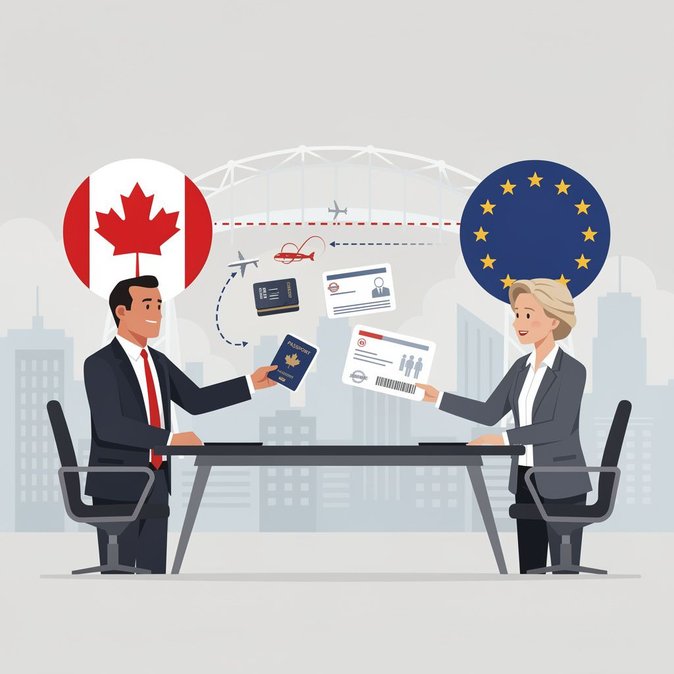
In Strasbourg on 18 September Prime Minister Mark Carney publicly embraced European Commission President Ursula von der Leyen’s surprise proposal to make Canada the European Union’s first “associate member”. While the political conversation so far has centred on trade and security, mobility experts say the concept—though undefined in EU treaties—could have far-reaching consequences for the movement of people. What an associate-member model might look like is still anyone’s guess; no legal text exists. But senior EU officials tell the Associated Press that Brussels is studying precedents such as the European Economic Area, the Swiss bilateral accords and the UK’s post-Brexit youth-mobility deal. Canadian diplomats are pushing for the right of Canadians to spend up to 180 days visa-free in the Schengen Area for business or leisure, automatic recognition of Canadian trusted-traveller programs and a fast-track work-permit corridor for intra-corporate transferees. In return, Ottawa would grant reciprocal privileges to EU citizens and align certain labour-market access rules with the EU’s Posted Workers Directive. For multinational employers the stakes are significant. The EU is already Canada’s second-largest foreign investment destination; easier business travel would reduce compliance costs for everything from short-term project work to training rotations. Mobility service providers also expect a boom in European postings if quotas and labour-market tests are waived. Immigration lawyers, however, caution that the deal could take years and would still require enabling legislation on both sides of the Atlantic. In the shorter term, companies should map their European footprint and assess which employee populations would benefit most from liberalised entry rules. They should also watch for interim measures—such as expanded International Experience Canada (IEC) youth quotas or bilateral social-security exemptions—that Ottawa could roll out ahead of any formal treaty. Finally, observers note that Washington is tracking the talks closely. If Canada secures preferential mobility rights with the EU, pressure will mount on the United States to modernise its own North American business-visitor regimes in order to stay competitive for Canadian talent.
Source: Associated Press