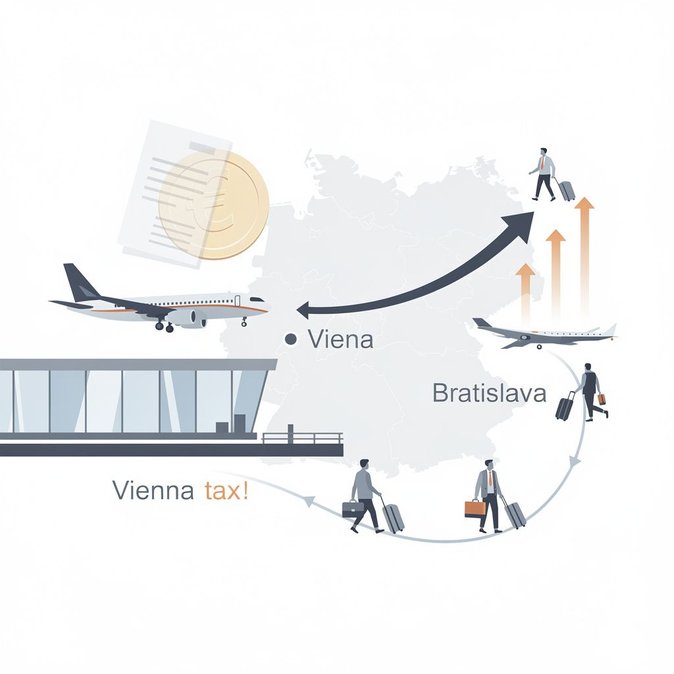
Vienna International Airport (VIE) is lobbying the federal government to scrap the country’s controversial flight-ticket tax after posting a 3.2 % drop in passenger numbers to 14.3 million in the first half of 2026. In an interview with ORF, board member Günther Ofner said the levy of €12 on medium-haul and €30 on short-haul tickets has driven price-sensitive airlines—and some two million passengers—to neighbouring Bratislava where charges are roughly one-third lower. Ofner argues that the tax, introduced in 2011 as an environmental measure, has failed to curb emissions and instead shifted traffic and jobs across the border. A study by the German Aerospace Center for the Austrian transport ministry found that while VIE’s own airport fees rose only 22 % since 2019, state-imposed costs such as air-navigation charges and the ticket tax have soared 85 %, almost double the European average. The resulting cost gap has already prompted low-cost carriers like Wizz Air and Ryanair to cut capacity or re-deploy aircraft. The loss of passengers has wider ramifications for Austria’s economy: fewer business-traveller arrivals mean lower spend on hotels, restaurants and conferences, weakening Vienna’s position as a Central-European hub. Ofner contends that abolishing the tax would be revenue-neutral for the treasury because returning traffic and ancillary spending would raise VAT and income-tax receipts. Tourism State Secretary Elisabeth Zehetner (ÖVP) said the government will review the figures, while the opposition FPÖ branded the tax “a job-killer”. Airport operators across the EU are watching closely. Only eight member states still levy a comparable charge after Germany halved its own fee this summer. An Austrian rollback could add momentum to a broader rethink of passenger taxes at a time when carriers face separate cost pressure from the EU’s Sustainable Aviation Fuel (SAF) mandate. For corporate travel managers, the debate is more than academic: a mid-haul business return ticket originating in Vienna currently costs €24 more than the same itinerary ex-Bratislava. If the tax is repealed—as Ofner hopes by the 2027 summer schedule—companies could see immediate savings and a wider choice of direct flights from Austria’s main hub.
Source: ORF (noe.ORF.at)